














Palworld breeding uses one male Pal, one female Pal, a Breeding Farm, cake, and an Egg Incubator. Version 1.0 keeps that basic loop but adds four special cakes and mutated eggs, so the cake you choose now changes what kind of result you are chasing.
Start with one goal: a specific species, better passive skills, higher talents, more eggs, or a mutation. Trying to perfect every part of the child at once burns through cake and makes it hard to tell whether a pair is improving.
New to version 1.0? Open the Palworld 1.0 guide hub for the larger progression path.
Palworld Breeding Quick Start
- 1. Reach player level 19 and unlock the Breeding Farm.
- 2. Place the farm inside a base with enough open space for two large Pals.
- 3. Assign one male and one female Pal to the farm.
- 4. Put the cake that matches your goal in the farm chest.
- 5. Wait for the pair to produce an egg, then move it to an Egg Incubator.
- 6. Check the child’s species, passive skills, and talents before deciding whether it should become a parent.
What You Need Before Breeding
A Breeding Farm
The Breeding Farm unlocks at level 19. Build it on flat ground inside a base boundary. Leave room around the entrance and the attached chest so both assigned Pals can reach their work area without getting stuck.
One Male and One Female Pal
The pair needs opposite sexes. Choose parents for the species result and the traits you want to pass down. A high-level Pal is not automatically the best parent if it carries several unwanted passive skills.
Cake in the Farm Chest
Breeding consumes cake from the small chest attached to the farm. Cake stored there does not spoil, which makes it a better place for your breeding supply than an ordinary food box.
An Egg Incubator
The farm produces an egg, not a ready Pal. Pick up the egg and place it in an incubator. Cake changes the breeding result before the egg appears; it does not directly shorten incubation time.
A clean base layout makes repeated breeding easier. Use the Palworld base guide for Palbox placement, work areas, and job routing.
Every Cake Effect in Palworld 1.0
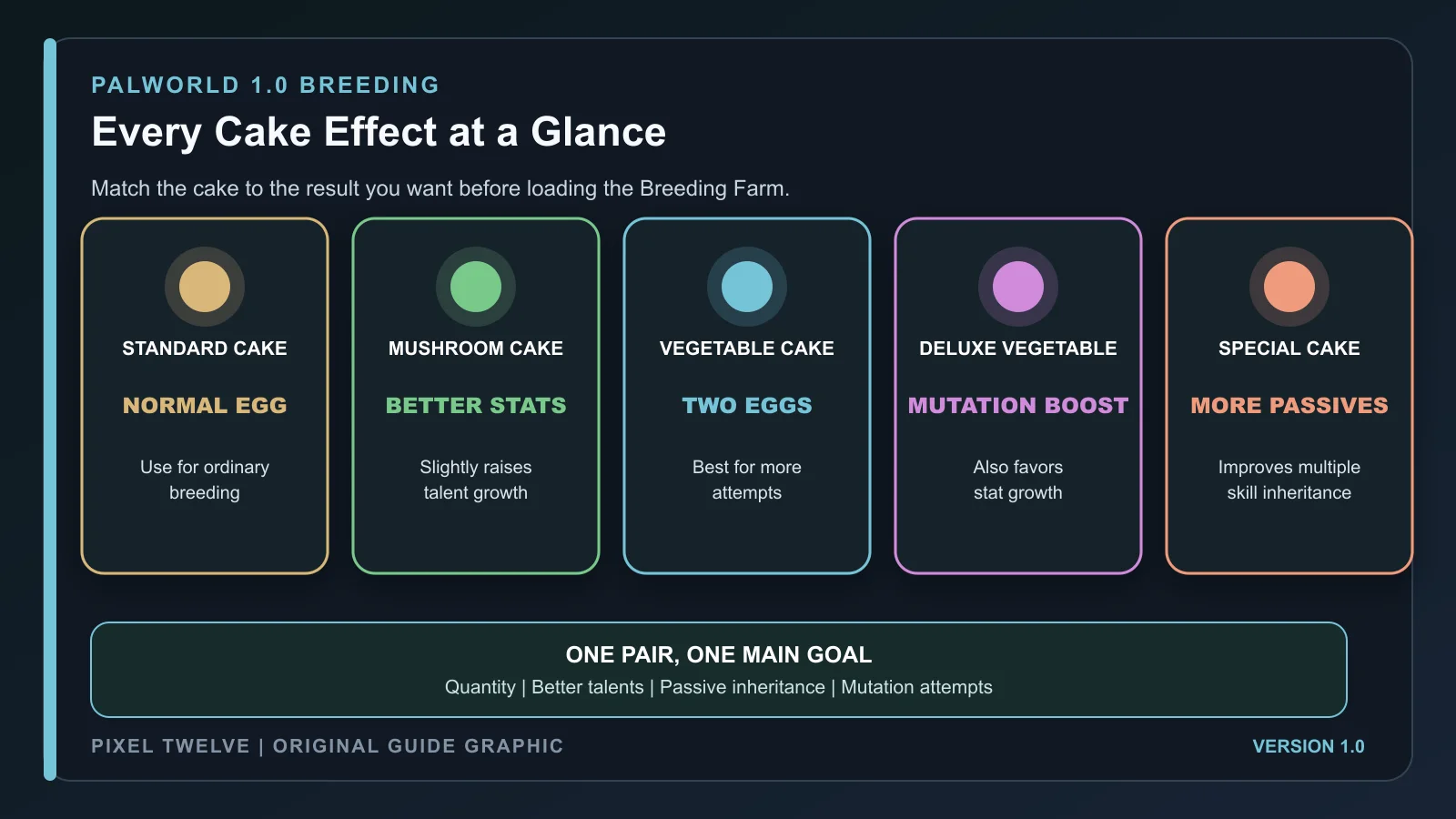
Standard Cake: Normal Breeding
Use the regular Cake when you want an ordinary egg and do not need a special bonus. It is the simple option for filling the Paldeck, testing a pair, or producing copies without spending advanced ingredients.
Mushroom Cake: Better Talents
Mushroom Cake slightly increases the chance that the newborn Pal has higher talents. Talents are the hidden natural quality behind core stats; many players call them IVs. Use this cake when the species and passive skills are already close to what you want.
Vegetable Cake: Two Eggs
Vegetable Cake produces two eggs in one breeding cycle. It is the quantity choice: more children to check, more possible passive combinations, and more copies for condensing or Paldeck work.
Deluxe Vegetable Cake: More Mutation Attempts
Deluxe Vegetable Cake increases the likelihood of a mutation and also makes stronger talent growth more likely. The cake improves the chance; it does not guarantee a mutated egg. Read the in-game cake description before loading the chest.
Special Cake: Multiple Passive Skills
Special Cake increases the chance that the child inherits several passive skills from its parents. Use it when the parents already carry the exact skills you want and the main goal is combining them on one Pal.
Which Cake Should You Use?
- Use Standard Cake for a normal result, early experiments, or simple Paldeck progress.
- Use Mushroom Cake when better natural stats are more important than egg quantity.
- Use Vegetable Cake when you need many eggs, copies, or more rolls quickly.
- Use Deluxe Vegetable Cake when mutation is the main goal and you accept repeated attempts.
- Use Special Cake when the parents hold valuable passive skills that need to meet on one child.
An “egg boost” can mean several things. The special cakes boost the breeding outcome, not the hatch timer. Vegetable Cake boosts quantity, Mushroom Cake favors talents, Deluxe Vegetable Cake favors mutation and talents, and Special Cake favors passive inheritance.
How Passive Skill Inheritance Works
The Child Can Inherit From Either Parent
Passive skills can come from the mother or father, but the result is not guaranteed. Spread the wanted skills across the pair and reduce unwanted skills when possible. A parent covered in bad passives gives the child more results you will need to discard.
Build a Better Parent in Stages
Suppose one parent has a movement passive and the other has a second speed bonus. Breed them until a child receives both. That child can replace one parent in the next pair, giving the following eggs a cleaner pool of useful skills.
Use Special Cake for the Final Combination
Special Cake is strongest when both parents are already prepared. Using it on random parents does not create the perfect skill set from nothing; it only improves the chance of inheriting several skills that are already available.

What Are Talents in Palworld?
Talents are the Pal’s natural stat quality. Players often call them IVs because they influence how strong the Pal can become even when two children share the same species and level. Better talents are useful for a final combat Pal, but they are not the first thing a new breeder needs to perfect.
A child with the right species and a clean set of useful passives is already a strong result. Chase excellent talents after the basic pair works and your base can supply cake without slowing everything else.
If the child is meant for combat, compare its future job with the best Palworld weapons and armor and the best combat, travel, and base Pals.
How Mutated Eggs Work
Mutation Is a Rare Breeding Result
Version 1.0 adds a low chance for an egg to become mutated. A Pal from a mutated egg can have higher talents and a unique passive skill. Mutation is an advanced improvement, not a requirement for finishing the story or exploring the normal world.
Deluxe Vegetable Cake Helps but Does Not Guarantee It
Prepare for several attempts. Keep useful non-mutated children too, especially when they combine the right species, passives, or talents. Throwing away every normal egg can waste the progress that makes the next pair better.
Mutated stats or passives not working?
The September 7 update to version 1.0.4 fixed a problem with extra Mutated Eggs produced through Grintale’s Passive Skill: those eggs did not reflect the mutated stat values. It also fixed the Idiosyncratic mutation passive failing to activate correctly. Update before comparing new breeding results, and check the hatched Pal’s stats and passives. The patch notes do not say whether previously hatched Pals or stored eggs are corrected retroactively.
Mutation and Awakening Are Different
Mutation happens during breeding. Awakening is a separate version 1.0 strengthening system that uses Radiant Gems after you already have the Pal you want to improve.
The Palworld Awakening guide explains that second upgrade path.
How to Choose Parents
Start With the Child Species
Use a breeding calculator that clearly supports Palworld 1.0. Pocketpair rebalanced breeding combinations, so an Early Access chart can return the wrong child. Confirm the pair before spending rare cake.
Remove Unwanted Passive Skills
A parent with fewer bad passives is often more useful than a parent with one great passive surrounded by three traits you never want. Clean parents make the results easier to sort.
Match the Pal to Its Job
Combat Pals may want attack, defense, movement, or survivability. Mounts value speed and travel utility. Base workers need passives that improve work speed, food use, or stability. Do not build every species around the same four skills.
For travel projects, compare the best ground, flying, and water mounts before locking in a long breeding chain.
A Simple Breeding Routine
- 1. Pick the exact species and job you want.
- 2. Check both parents for sex, passive skills, talents, and the expected version 1.0 child.
- 3. Choose one cake based on quantity, talents, passives, or mutation.
- 4. Hatch every egg and move obvious rejects away from your active Palbox pages.
- 5. Promote a better child into the next pair when it carries more of the final build.
- 6. Stop when the Pal is strong enough for its real job.
Perfection is expensive. A clean build that solves the fight, mount route, or base job you care about is more valuable than hundreds of extra eggs sitting in storage.
How to Speed Up a Breeding Base
Keep the Farm Close to the Palbox
Short routes make it easier to replace parents, collect eggs, and fix an assignment. Do not crowd the farm with walls, storage, or production stations that can block a large Pal.
Separate Cake Production From the Farm
A dedicated food area can grow and process ingredients while the breeding base stays open and easy to manage. Store finished cake in the farm chest so it does not spoil.
Use a Clear Sorting System
Reserve Palbox pages for active parents, promising children, final builds, and condensing copies. Naming or sorting your goal outside the game can save more time than producing another batch you cannot compare.
Level gates still control many useful structures. The Palworld leveling guide can help if the next breeding upgrade is still locked.
Common Breeding Mistakes
- Using an old calculator: version 1.0 changed combinations, so verify the tool’s update label.
- Choosing cake before the goal: decide whether you want quantity, talents, passives, or mutation first.
- Keeping every child: sort after each hatch so useful parents do not disappear in a crowded Palbox.
- Ignoring unwanted passives: cleaner parents usually save more cake than one lucky final roll.
- Chasing mutation too early: finish a useful normal build before spending late-game ingredients on rare attempts.
- Blocking the farm entrance: leave enough space for both parents to reach the assigned area.
Palworld Breeding FAQ
What Level Unlocks the Breeding Farm?
The Breeding Farm unlocks at player level 19.
Do You Need One Male and One Female Pal?
Yes. The farm needs one parent of each sex.
Which Cake Gives Two Eggs?
Vegetable Cake produces two eggs in one breeding cycle.
Which Cake Helps With Passive Skills?
Special Cake increases the chance that the child inherits multiple passive skills from its parents.
Which Cake Helps With Mutations?
Deluxe Vegetable Cake increases the likelihood of mutation and also favors stronger talent growth.
Does Cake Make Eggs Hatch Faster?
No. The cake changes the breeding result before the egg is produced. Incubation is a separate step.
Can Old Breeding Calculators Be Wrong?
Yes. Use a calculator or database marked for Palworld 1.0 because breeding combinations were rebalanced.
After you hatch the Pal you want, the Palworld accessories guide can help finish the player-side build around it.