






Valorant ranked looks simple until a win gives you less RR than the loss before it took away. The number on the Competitive screen is Rank Rating, but Riot also tracks a hidden matchmaking rating called MMR. Those two values work together, which is why players with the same badge can receive different gains and losses.
The short version: RR moves your visible rank, while MMR tells the matchmaker where it thinks you belong. Winning is the largest factor, but round differential, individual performance, and the distance between your rank and MMR can all change the final number.
Valorant ranks and RR at a glance
- Competitive unlock: Account Level 20.
- Rank order: Iron, Bronze, Silver, Gold, Platinum, Diamond, Ascendant, Immortal, and Radiant.
- Tiers: Every rank except Radiant has three tiers.
- Starting RR after placement: 50 RR in the rank you receive.
- Promotion: Reach 100 RR. You enter the next tier with at least 10 RR.
- Demotion: Lose at 0 RR after your protection is gone. You enter the lower tier with no less than 70 RR.
- Rank decay: There is no normal rank decay, although Immortal and Radiant leaderboard positions can move.
Every Valorant rank in order
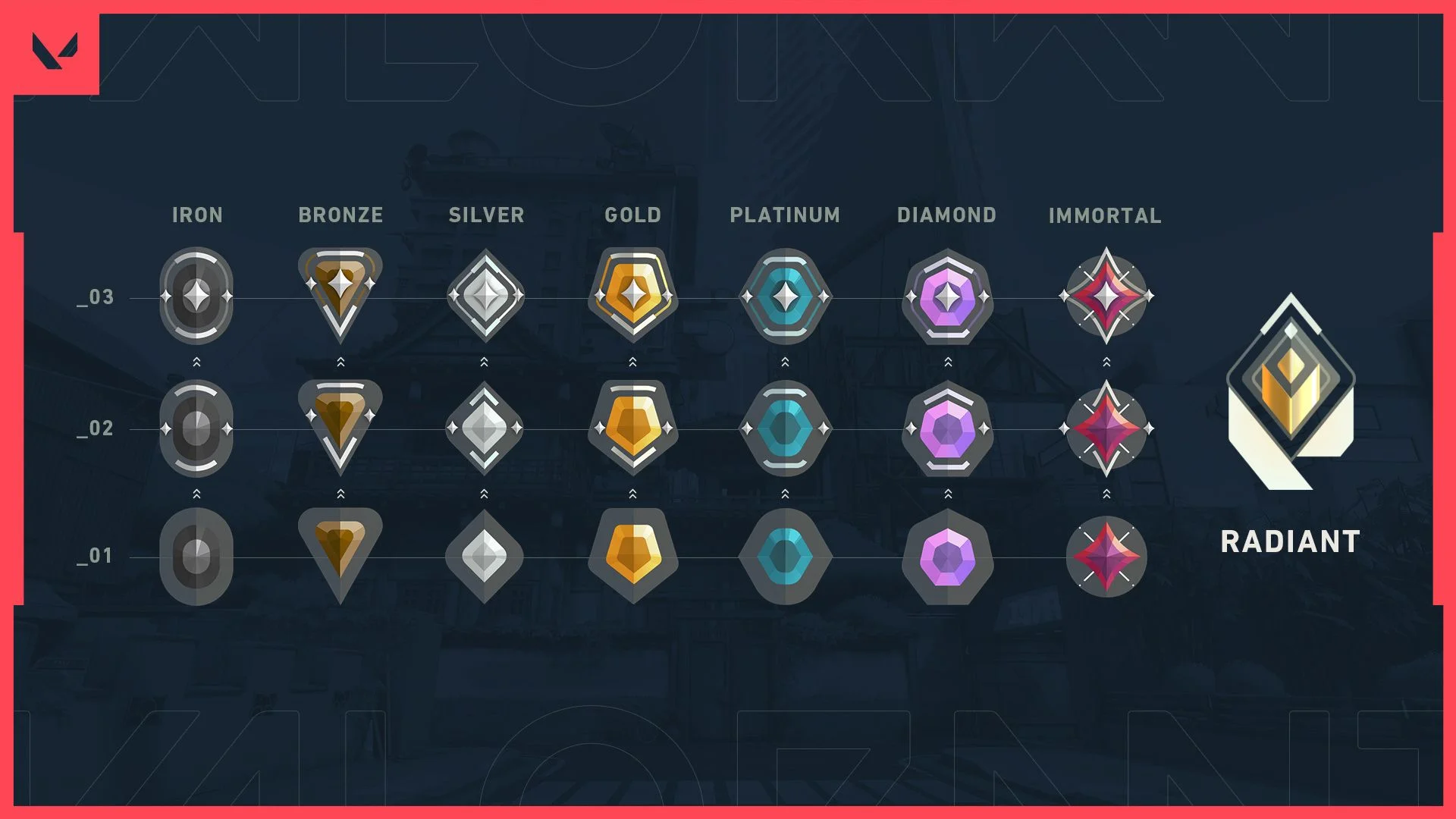
The ladder starts at Iron and ends at Radiant. Iron through Immortal each have three tiers: 1, 2, and 3. A higher tier number is better, so Gold 3 sits above Gold 2. Radiant has no numbered tiers and is reserved for the very top of the leaderboard.
- Iron 1, Iron 2, Iron 3
- Bronze 1, Bronze 2, Bronze 3
- Silver 1, Silver 2, Silver 3
- Gold 1, Gold 2, Gold 3
- Platinum 1, Platinum 2, Platinum 3
- Diamond 1, Diamond 2, Diamond 3
- Ascendant 1, Ascendant 2, Ascendant 3
- Immortal 1, Immortal 2, Immortal 3
- Radiant
Your visible rank is the badge other players see. Act Rank is different: it records your proven performance across the Act and is based on your highest ranked win.
How to unlock Competitive and complete placements
New accounts unlock Competitive at Account Level 20. The old requirement to win 10 Unrated matches is no longer the normal rule.
Riot divides the year into six Acts. At the start of Act 1 and Act 4, players complete five placement matches. If you already completed those placements, Acts 2 and 3 use one placement match to update your rank. A difficult placement can lower the visible rank, but the system does not erase everything it already knows about your account.
Iron-through-Ascendant players begin with 50 RR after placement. Riot currently caps the highest initial placement at Ascendant 3.
What RR means in Valorant
Rank Rating is the visible number that tracks progress inside your current tier. A win adds RR and a loss removes it. Reaching 100 RR promotes you, while dropping to 0 RR puts the next loss in danger of causing a demotion.
RR is not a fixed price for winning or losing. Two 13-9 wins can pay differently because the system also considers the opponents, your hidden MMR, and how you performed. Riot does not publish a calculator that lets players predict an exact number before the match starts.
How Valorant calculates RR
Riot lists four main parts of the calculation:
1. Match result
Winning or losing has the largest effect. Team results matter more than chasing a high kill count while the round slips away.
2. Round differential
A dominant result moves RR more than a close one. Riot uses a 13-2 win versus a 13-9 win as its example: both are victories, but the first shows a wider performance gap. The same idea applies to losses, so an 11-13 defeat usually hurts less than a 3-13 defeat.
3. Individual performance
Damage, assists, and other contributions can slightly improve a gain or soften a loss. Kills are not the only personal stat involved, and this part of the calculation matters less than the match result. It has even less weight in Immortal and Radiant, where team wins carry more of the load.
4. Rank convergence
The game compares your hidden MMR with your visible rank. If MMR is higher, wins tend to pay more and losses tend to cost less. If MMR is lower, gains shrink and losses grow while the system tries to bring the badge back toward its skill estimate.
What MMR means and why you cannot see it
MMR is Riot’s hidden matchmaking rating. It places every player on a large skill ladder and helps build fair matches. Your rank is a visible milestone; MMR is the system’s current estimate of where you belong.
The two values are separated so one unusually good or bad night does not make the badge swing wildly. A new placement or strong win streak can move your visible rank away from MMR for a while. RR gains then push the two values back toward each other.
There is no screen, website, or legitimate tracker that can reveal the exact MMR number. You can only read the direction indirectly: consistently gaining more on wins than you lose on defeats usually suggests MMR is above the badge, while the opposite pattern suggests it is below.
Why did I lose around 20 RR?
A loss of about 20 RR is not a special punishment by itself. It can come from the normal base loss, a wide round differential, and negative convergence if your visible rank is above your MMR. AFK behavior or repeated queue dodges can add separate penalties.
One result is not enough to diagnose the account. Compare several wins and losses. If the pattern keeps taking more RR than it gives, Riot’s current guidance is straightforward: win more consistently and improve individual impact so MMR rises.
Promotion, demotion, and Rank Shields
Reaching 100 RR promotes you. The new tier starts with at least a 10 RR buffer, so one immediate loss does not automatically erase the promotion.
Demotion requires reaching 0 RR and then losing again. After the drop, the lower tier starts at no less than 70 RR. Rank Shields add another layer of protection when you enter Tier 1 of a rank, such as Silver 1 or Gold 1.
You receive two Rank Shields when entering Tier 1 through promotion or demotion. A shield can absorb a loss at 0 RR that would drop you into the rank below. Shields do not protect movement between numbered tiers, such as Silver 2 to Silver 1. Dodges and remakes do not consume a shield.
Can you gain RR after losing?
No. Riot’s current RR guide says a loss cannot award positive RR. An exceptional performance can still improve hidden MMR and reduce how much RR the defeat removes, which may help future gains.
Playing Competitive with friends
Groups of two or three must stay within Riot’s rank-disparity limits. Iron and Bronze players can queue up to Silver; Silver can queue with Gold; Gold can queue with Platinum; and players from Platinum upward can group within one full tier. A Platinum 2 player, for example, can queue with someone as high as Diamond 2.
Four-player Competitive groups are not allowed because the fifth teammate would be a solo player. Immortal 1 and higher players can solo, duo, or use a full five-stack.
Five-stacks can ignore the normal rank range, but large disparities reduce RR. Riot applies penalties based on the highest ranks and the gap inside the group, so a five-stack may play together while earning much less progress.
How RR refunds work after a cheater ban
If Riot confirms and bans a cheater who caused your Competitive loss, the RR Refund system can restore part of the lost rating. Refunds normally arrive 24 to 48 hours after the ban, and you must finish another Competitive match to trigger the update on your account.
Refunds apply within the current Act and have caps. They can also shrink if you climbed several tiers after the affected match. The post-match screen shows the net result, so a refund may reduce a new loss instead of appearing as a separate positive number.
How to improve RR gains without chasing the number
The only reliable way to improve the pattern is to win more consistently against the players around your MMR. Focus on choices that raise round win rate: trade teammates, buy with the squad, communicate useful information, and avoid giving away the first death.
If ranked systems still feel overwhelming, use the Valorant beginner guide to build the basics first. The Valorant economy guide can also help turn more close rounds into wins by fixing bad buy decisions.
For maps, settings, and the rest of the learning path, open the Valorant guide hub.
Valorant RR and MMR FAQ
How much RR do you need to rank up?
Iron-through-Ascendant players need 100 RR. After promotion, the new tier begins with at least 10 RR.
What is the maximum rank after placements?
Riot currently lists Ascendant 3 as the highest initial placement.
Does Valorant have rank decay?
No normal rank decay applies. Immortal and Radiant players can move down the leaderboard as other players pass them, but Riot does not classify that as rank decay.
Can a good K/D give RR in a loss?
No. Individual performance can soften a loss and may improve hidden MMR, but the match still removes RR.
Why do two players in the same rank gain different RR?
They may have different hidden MMR, face different opponents, finish with different round margins, or contribute differently in the match. The visible badge alone does not determine the payout.