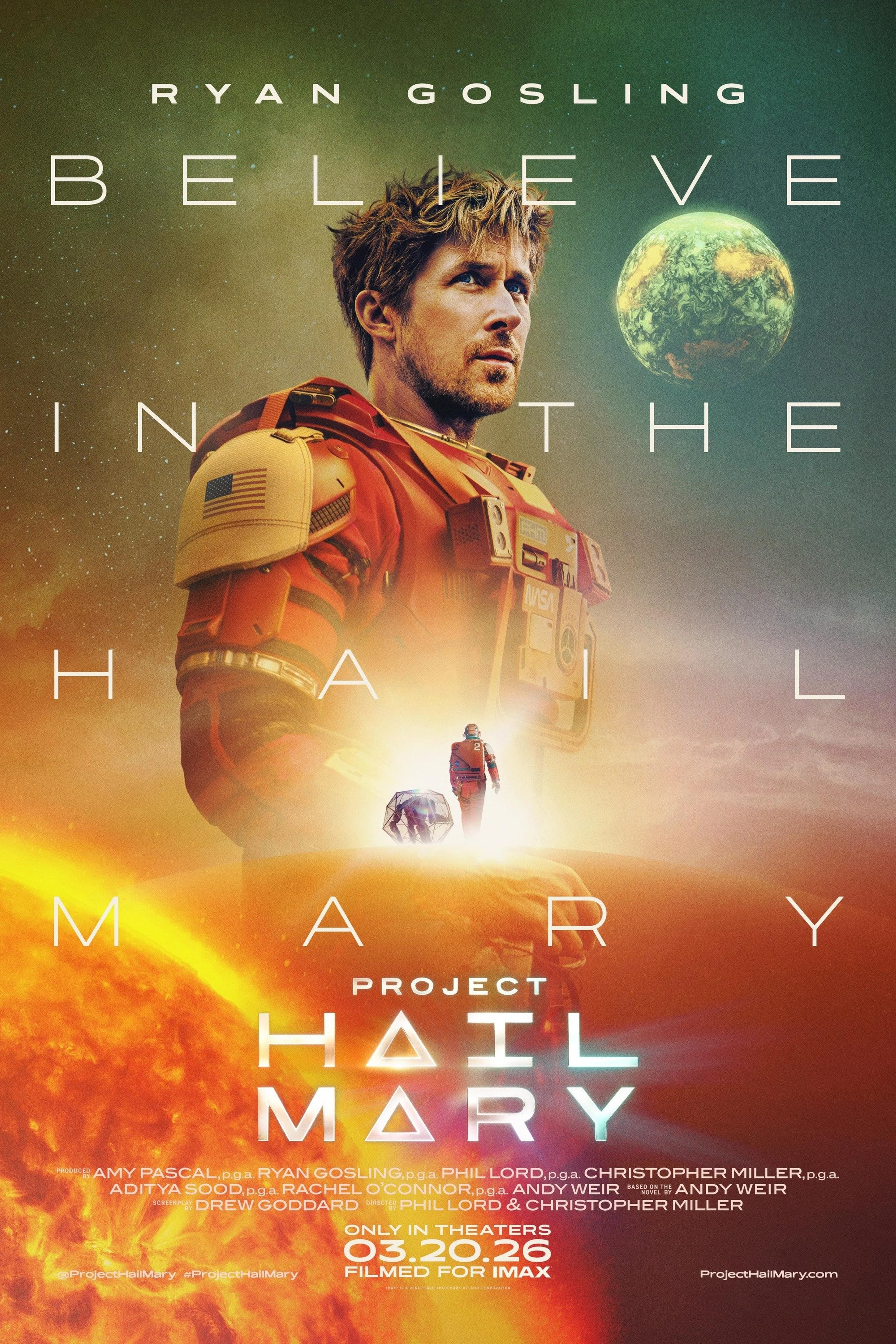
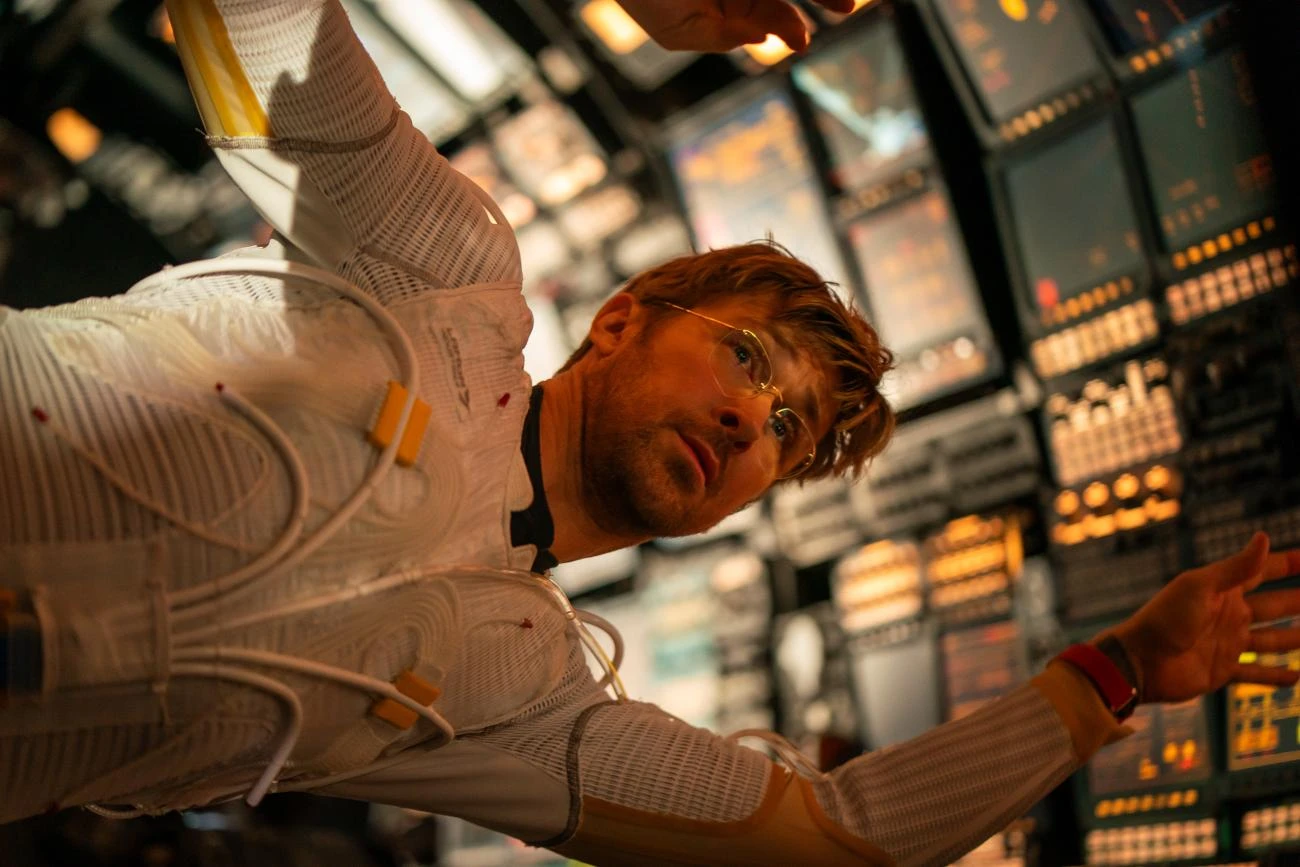
Ryland Grace wakes up on a spaceship without remembering his name or how he got there. Moving around is difficult. The equipment is unfamiliar, and nobody is answering his questions. Ryan Gosling makes this opening funny without making Grace seem comfortable. He is trying to understand a frightening situation while struggling with things that an experienced astronaut would probably handle without thinking.
Grace is not an experienced astronaut. He is a science teacher, and the explanation for his journey arrives in scenes that return to his life on Earth. Something is causing the sun to lose energy. Unless a solution is found, life on our planet is in danger. Project Hail Mary makes a huge problem easy to understand before asking us to follow the science. We know what Grace needs to accomplish even when he does not yet know how.
Directors Phil Lord and Christopher Miller turn Andy Weir’s novel into a funny space adventure with an unusually likable pair of leads. Gosling shares the film with Rocky, an alien whose home faces a similar disaster. Their friendship is the best reason to watch. The jokes occasionally make the danger feel less serious, and the Earthbound characters deserve more time. But Grace and Rocky make this a very easy film to recommend. We discuss the setup and their early relationship below, not the ending.
A teacher has to work out how to save the sun
The threat comes from a tiny organism that takes energy from stars. The mission sends Grace toward a distant star that has not suffered the same damage. His job is to find out why and help Earth survive. The film calls the organism “astrophage,” but the important point is what it does. You do not need to memorize scientific terms to follow the mission. You need to understand the problem he is testing and what a successful result would change.
Grace works through those questions by observing things, trying ideas and checking the results. Drew Goddard’s screenplay usually explains enough of that process to let us participate. A discovery is more satisfying when we understand what he was looking for. The film does not make every calculation easy to follow, but it rarely leaves us wondering why an experiment matters in the first place.

His earlier work as a teacher helps establish the right tone. He is someone used to making a subject interesting for people who do not already know the answer. Gosling can make an explanation sound excited rather than dutiful. Grace’s enthusiasm makes the science scenes fun to watch. He enjoys figuring something out, and that feeling is more inviting than a speech designed only to tell us how clever the main character is.
At the same time, knowing science does not mean he is ready for everything aboard a spacecraft. The opening makes that difference visible through his awkward movements and worried reactions. Gosling is good at letting confidence disappear halfway through a task. A man can understand a problem and still be scared of what he has to do about it. That keeps Grace from becoming an expert who always has the correct answer immediately.
The return trips to Earth gradually explain why this particular teacher became involved. They also give us a break from watching him alone on the ship. The two timelines answer different questions: how he got there and what he can do now. Most of the transitions are easy to follow. They work best when an earlier conversation changes how we understand the person handling the next emergency.
There is a cost to keeping part of his history hidden. Some information about the mission arrives later than we wanted, after we have already formed an impression of the people involved. We will not reveal that information. The frustration is that the film gives itself less time to examine the difficult feelings it raises. For a story lasting more than two and a half hours, a few important human questions receive surprisingly little attention.
The scientific explanations have a different limit. Watching someone work through a problem can be exciting, but not every step needs the same emphasis. Sometimes Grace explains a conclusion after the picture has already helped us reach it. The film is welcoming to newcomers, though it occasionally explains more than it needs to. That is a smaller problem than making the mission impossible to follow, but it does add to the length.
Rocky is a partner, not just a cute passenger
When another spacecraft appears, Grace is no longer the only person looking for an answer. Its occupant is a creature he names Rocky, with several limbs and a rough body that resembles stone. Rocky does not have a human face or speak Grace’s language. Before they can tackle the larger problem, they have to establish what the other is trying to say. Helping each other begins with small exchanges rather than instant understanding.

Rocky is expressive without being given a human-looking face. His movements tell us when he is curious, eager or concerned. That makes him more interesting than a familiar human character with a different skin color. James Ortiz’s performance and the creature work give Gosling something that feels present beside him. We can believe Grace is responding to another individual, not waiting for an effect to appear after filming.
Their first communication depends on connecting sounds with meanings. A translation system eventually lets them have conversations, which is where much of the comedy develops. The process is simplified, and viewers hoping for a detailed account of learning an alien language may want more. But the basic idea is understandable: they need to build shared knowledge before either can explain a plan.
Once they can talk, their different assumptions produce better jokes than a constant stream of comments from Grace alone. Rocky can be funny because he takes a situation differently, not because he is stupid. He has knowledge and abilities that Grace needs. Their cooperation is satisfying because both contribute something. The human is not simply teaching an alien how to behave while doing all the important work himself.
Project Hail Mary film images
3 screenshotsThis is also where the film becomes more emotionally involving. At first, saving Earth is a duty so large that it is difficult to picture. Caring about the other traveler is more immediate. We understand what it means for one of them to need help while the other has a reason to stay safe. The friendship gives the mission a personal cost that a diagram of a dying star cannot provide.
Gosling is especially good when Grace's joking stops for a moment. His expression can suggest loneliness without a long explanation of it. Rocky gives him someone to speak to who is not just a camera recording his thoughts. The change is welcome. Conversations can surprise him in a way that another video diary cannot, and the film becomes livelier when it allows the pair to disagree or misunderstand each other.
Not every joke helps. Grace can react to another dangerous situation with a comment that makes it sound like a minor inconvenience. We sometimes wanted the film to let a frightening moment stay frightening. The problem is not that a space adventure is funny. It is that laughter arrives so quickly after certain threats that there is little time to feel how badly things could go.
The scale of the images helps recover some of that danger. Inside the ship, Grace is surrounded by controls and equipment he has to use. Outside it, he looks small and vulnerable. Greig Fraser’s photography makes those spaces feel different, while Daniel Pemberton’s music adds excitement without being the only thing telling us to care. The film gives a conversation and a view into space very different visual demands, and generally handles both well.
Sandra Hüller makes the scenes on Earth worth returning to
Eva Stratt is responsible for getting the mission ready, and she does not have the luxury of waiting until everyone feels comfortable. Sandra Hüller plays her with a directness that contrasts with Grace’s hesitation. When he sees another reason something will be difficult, she needs to know what can actually be done. Their conversations are entertaining because they are approaching the same emergency with very different priorities.
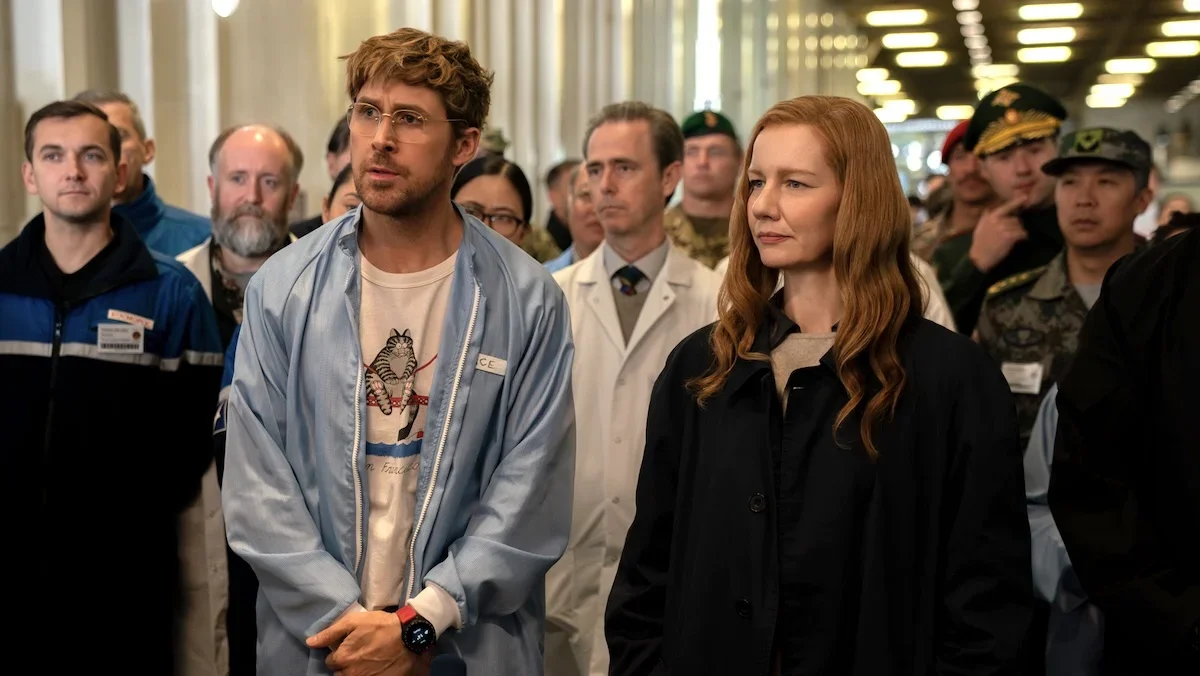
Hüller makes Stratt feel like more than the person who explains the assignment. Her restraint suggests the effort involved in keeping a large operation moving while the consequences are so severe. A quieter singing scene offers a welcome change from her professional manner. It lets her exist for a moment without having to give another order, and makes us wish the film allowed more time for that side of her.
The other people helping to prepare the mission are less memorable. There is an international effort behind the spacecraft, but most of the supporting cast receives only brief opportunities to stand out. We understand that many people are working on the problem without getting to know many of them. Earth feels less fully developed than the friendship in space. That is a noticeable limitation in a story whose goal is to save everyone back home.
The film does not need a separate subplot for every scientist or crew member. A few more specific relationships would have been enough to make the world Grace leaves behind feel less distant. We are much more attached to the two travelers we spend time with. That is partly a sign of how well their scenes work, but it also means the human characters on Earth cannot always match them.
For viewers choosing what to watch, the tone matters more than familiarity with the novel. This is a hopeful adventure about solving problems together, not a grim account of human extinction. That choice is responsible for many of its best moments as well as its occasional lack of tension. Expect awkward humor and affection alongside the experiments and danger. Neither the book nor The Martian is required beforehand.
Set aside roughly two hours and 36 minutes. The film is rated PG-13 and is available on Prime Video, including in the United States. Its accessible explanations make it a reasonable choice for older children interested in space, though the opening includes dead crew members and the mission involves serious danger. The running time may be a bigger obstacle for some families than the scientific vocabulary.
Pixel Twelve score: 8.3/10 — Great. Gosling and Ortiz make Grace and Rocky worth spending that time with. The experiments give their adventure a purpose, and the creature work makes the friendship convincing. Too many quick jokes soften some dangerous moments, while Stratt and the people on Earth get less attention than they deserve. Even so, this is an inviting science-fiction film with characters we care about, whether or not we understand every calculation.
Loading results