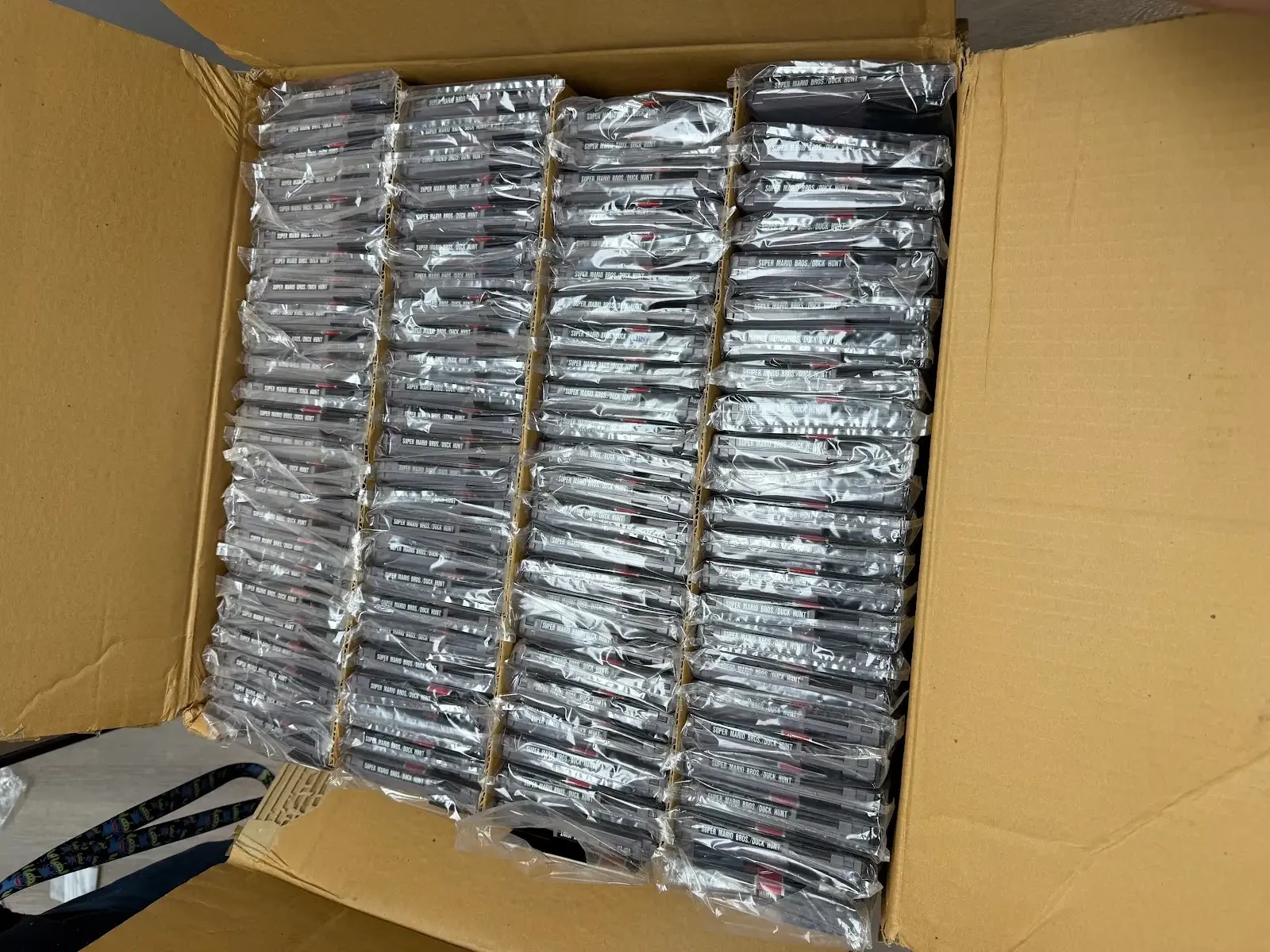
A cardboard box in a Wisconsin retro game store looked like a stash of one of the most common NES pack-ins ever made. Then collector and Nintendo Wire editor Jason Ganos opened it and found 97 pristine copies of Super Mario Bros./Duck Hunt, each wrapped with an unused manual tucked behind the cartridge.
The quantity alone was unusual. The bigger surprise came when collectors studied the labels, manuals, and production codes. They did not match any version that had been documented before.
The find is not a lost Mario game or a different adventure. It is a previously undocumented manufacturing variant of the familiar Super Mario Bros./Duck Hunt cartridge, preserved in a condition that is almost impossible to recreate more than 30 years later.
What was inside the box?
Ganos reported that the box held 97 individually wrapped cartridges and 97 clean manuals. A label on the outside listed a quantity of 100, which suggests that three copies disappeared somewhere along the way.
The shipping box carries a December 19, 1995 date and describes the contents as “Mario - Hunt Remanufactured NES.” Another label contains Japanese text that translates to 100 assembled NES cartridges. The paperwork makes the box interesting on its own: it appears to have moved from Japan to Nintendo of America very late in the NES era.
For a closer look at the game behind the discovery, the Super Mario Bros. game page covers the original release and its place in Nintendo history.
What Is Different About These Cartridges?
At first glance, they look like ordinary Super Mario Bros./Duck Hunt cartridges. Turn one over, though, and the difference appears. Most known copies have an English-only label. These use several languages. The manuals have a tiny wording change too: “maintenance or service” instead of the familiar “maintenance or repairs.” Small changes, but collectors use exactly these details to identify where and when a game was produced.
The production code makes the mystery more interesting. Code 9340 points to the 40th week of 1993, after the console bundles known to include this cartridge had already been produced. Investigators even opened one copy to inspect its circuit board, while grading specialists examined the rest of the lot.
What nobody can explain yet is why Nintendo had so many of them. They may have been replacement cartridges for warranty claims, stock for refurbished consoles, or part of a bundle that never went on sale. Those ideas fit the evidence, but Nintendo has not confirmed any of them.
The cartridges reportedly escaped being destroyed
The history of the box is almost as strange as the contents. According to the account given to Ganos by shop owner Kevin Braun, the games came through a precious-metal recovery business that handled unwanted circuit boards. The cartridges were reportedly meant to be broken down so the gold on their contacts could be recovered.
Instead, the box survived. It spent more than 20 years in a garage, later reached Braun’s retro shop, and then sat forgotten in storage for several more years. The shipping labels support parts of that route, but Nintendo has not publicly confirmed the full chain of custody or the reason these cartridges were sent out.
That distinction matters to the story. The physical evidence is real and has been examined, while the explanation for why the box left Nintendo remains an informed reconstruction rather than an official company record.
Five cartridges received a PSA 10
Ganos and Braun took the entire lot to PSA for authentication and grading. The first group included one PSA 10, and five cartridges eventually received that top grade. Many others were graded 9.8 or 9.6.
The first three copies are scheduled for Goldin Auctions on August 12, 2026, including one of the PSA 10 cartridges. No reliable market value exists yet for a newly documented variant like this, so the auction should give collectors their first real price signal.
Braun and Ganos plan to keep an undecided number of cartridges. Other copies may be sold later, and some are expected to be used for charity auctions.
Why collectors care about a common NES game
Super Mario Bros./Duck Hunt is not rare in the usual sense. Millions of players received it with an NES, and loose copies remain easy to find. This box is different because it preserves an entire late production run with matching manuals, unusual labels, and a shipping container that helps explain where the cartridges went.
Small manufacturing changes are easy to lose when a product is treated as ordinary. Here, 97 matching copies survived together, giving preservationists enough material to compare labels, codes, boards, and manuals instead of relying on a single unexplained cartridge.
- Confirmed: 97 wrapped cartridges and manuals were found in the original shipping box.
- Documented difference: multilingual back labels and altered manual wording.
- Still unknown: why the late production run existed and why it was sent to recovery.
- Next milestone: the first three graded copies are scheduled for auction on August 12.
For a newer corner of Mario history, Super Mario Sunshine comes to Switch 2 on August 13, one day after the first cartridge auction is scheduled to begin.