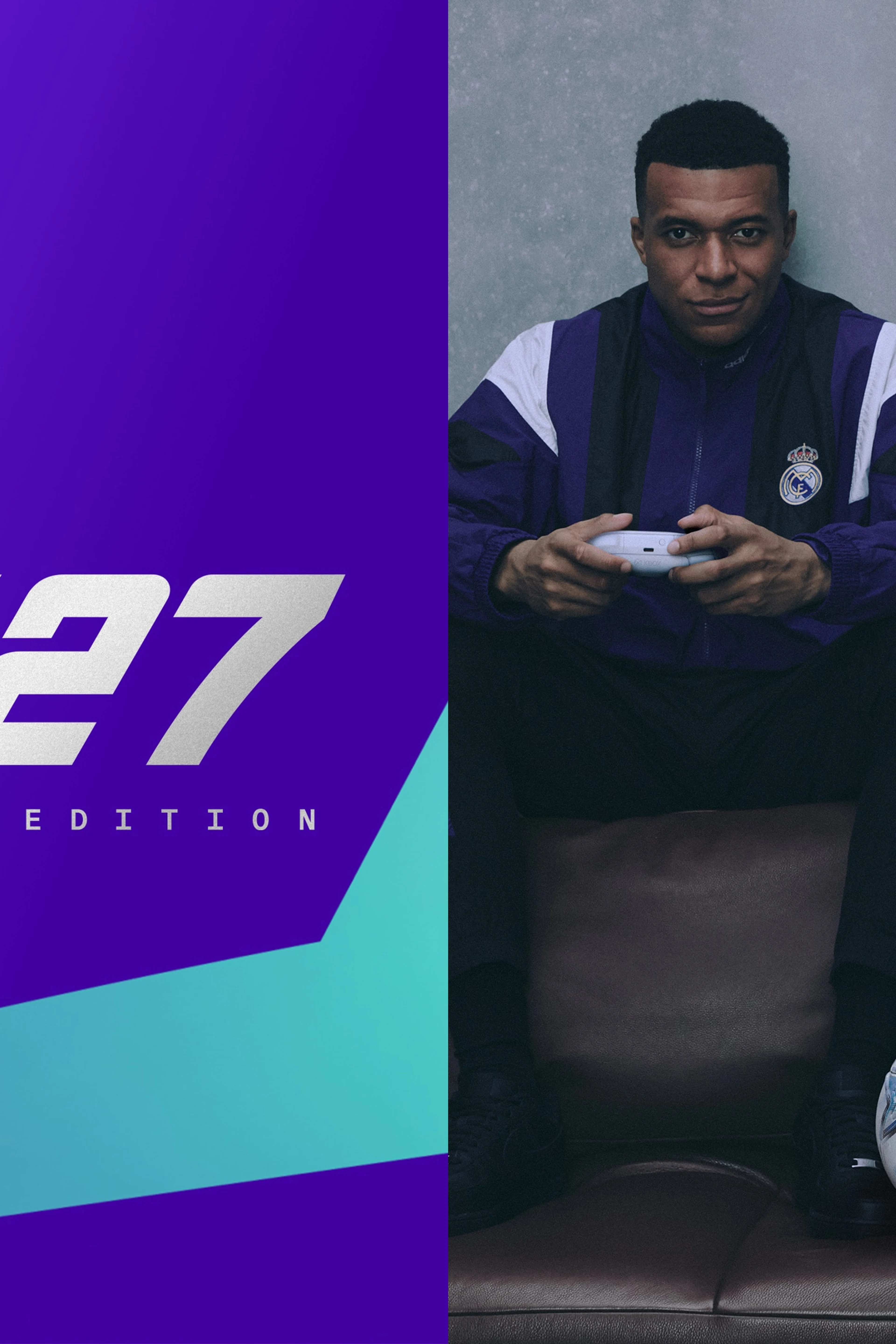

EA Sports FC 27 is a football game in which you pass, tackle and shoot while controlling players on a team. You can play a single match, manage a club through several seasons, collect footballer cards to assemble another team, or create a player to join other people online. It replaces the old FIFA name, but you do not need to have played FIFA or FC before to understand its best changes.
The most worthwhile change happens when the other team attacks. In competitive matches, the defender you control is more important than a teammate left to the computer. Manager Career also gives you more decisions about how to pay for a new signing. Those are good reasons to consider FC 27. They are not enough to excuse unreliable online play or paid advantages in Ultimate Team. This review reflects the launch period and the October 2 updates, not promised future fixes.
Who’s who—and who you control
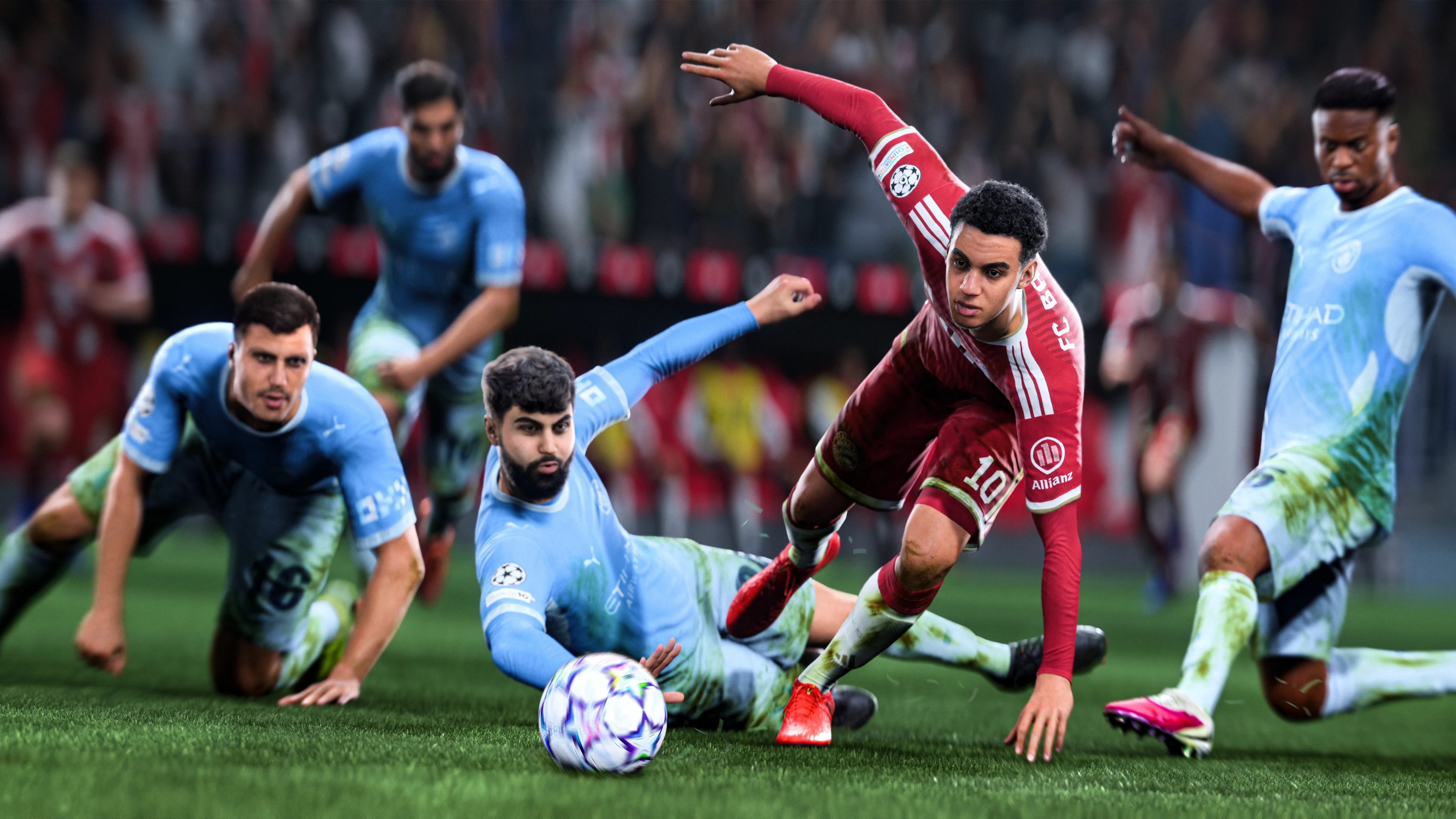
Jude Bellingham and Jamal Musiala are real footballers represented in the game. Bellingham is the player tackling in our cover image; Musiala is the Bayern player in the red shirt below. You switch between footballers when controlling a whole team.
Cody Gakpo and the opposing manager appear in the transfer example below. Gakpo is the footballer you are trying to sign. The manager on the call represents the club selling him; you are negotiating its price, not controlling that manager during a match.
Your manager is the person whose club you run in Manager Career. You choose signings and the starting team, then play matches or let the game calculate their results.
Your Pro is a footballer you create for The Grounds and Clubs. Here you normally control that individual, rather than switching around an entire team. Clubs lets people use their own Pros together in team matches.
Defending a match and running a club
When an opponent carries the ball toward your goal, you select a defender, move into the attacker’s path and choose when to attempt a tackle. Other defenders still move into position, but in the faster Competitive rules used for modes such as Ultimate Team, they no longer routinely begin tackles for you. You have to take control to win the ball, rather than expecting a nearby computer-controlled teammate to do that work.
That makes staying alongside an attacker more useful. Rush forward too soon and they can move past you; wait for a heavy touch and you have a better chance to reach the ball. We like that the successful tackle has a clear cause: you chose the defender, closed the distance and timed the challenge. For a new player, though, this is also a reason to practise before entering online competition. The slower Authentic rules used for offline play do not apply all the same defensive changes.
Credits
Electronic Arts (official screenshots and gameplay demonstrations).Attacking has another useful change when the ball is kicked in from the corner of the pitch after a defender sends it over the goal line. That restart is a corner kick. You choose the delivery, then briefly move the teammate waiting near goal before the ball reaches them. The corner is no longer just the kicker’s decision. You can move away from a marker or protect the space where you want to meet the ball with your head.
The clip below shows that switch: the camera moves from the kicker to the players waiting in front of goal. This extra control makes those crowded seconds more interesting. It also adds another action for a beginner to learn. A clever delivery still does not guarantee a clean header if your receiver is in the wrong place.
Passing needs the same care. A through ball is a pass into space for a teammate to run onto, rather than straight to their feet. FC 27 follows your aiming direction more closely, so looking for an open route matters. The trouble is that players also report passes going somewhere unexpected and difficulty switching to the player they want. Better manual control makes those mistakes more frustrating, because selecting the wrong defender can leave an attacker free. Not every bad pass is a bug, but the complaints cannot simply be dismissed as people failing to learn the controls.
Manager Career gives transfers a clearer purpose
Away from the match, you decide which footballers your club needs and how much it can spend. To sign someone, you negotiate with their club and then arrange the player’s contract. FC 27 lets the clubs discuss payments spread over time and extra conditions, rather than treating every deal as a single price paid immediately. A cheaper payment today can still mean a large bill later. That is a useful management decision, not just another screen to click through.
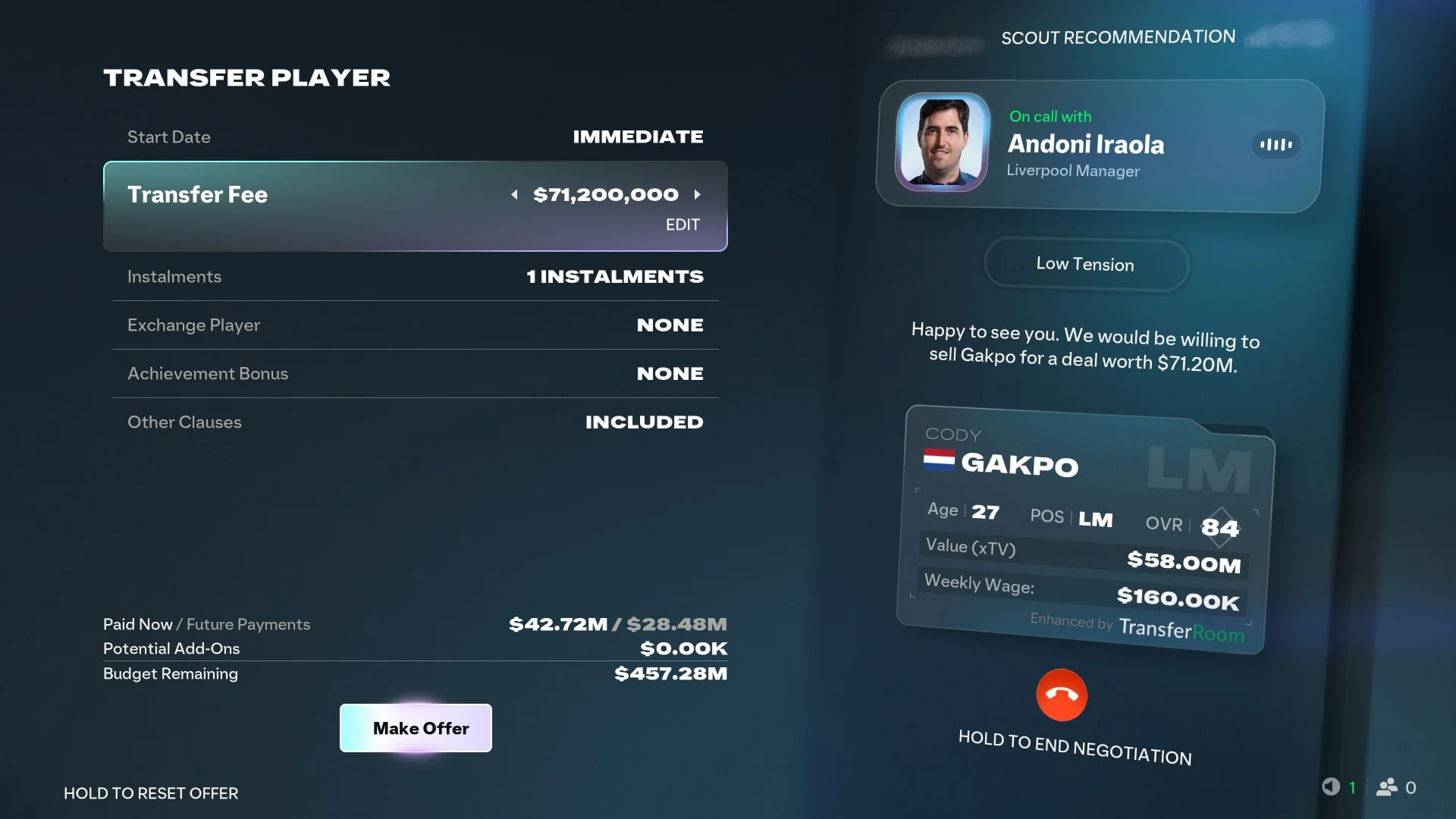
In the transfer screen above, the asking price for Gakpo is $71.2 million, with $42.72 million paid now and $28.48 million later. Those are figures in the game’s example, not a real transfer fee. The split makes the question easy to understand: can you afford this player now without leaving too little money for the rest of the squad? This is the part of Career we find more interesting than merely buying the highest-rated footballer available.
You also have to reconsider who starts each match. A footballer’s overall rating is the game’s summary of their ability. Form, fitness and morale can now change that number during a career; the feature is called Dynamic OVR. The rating beside a name is not a permanent answer. A player struggling for fitness may be a worse choice than a fit teammate. This gives a reason to follow what is happening to your squad between matches, although it also means more information to check before picking the team.
Ultimate Team collection and The Grounds
In Ultimate Team, you obtain cards representing footballers and use those cards to assemble a squad. Matches and objectives provide rewards. You can also buy virtual currency, called FC Points, and spend it on packs containing random items. A paid pack does not promise the particular star you want. The ability to pay for more chances at stronger cards still affects the competition. Optional spending is not the same thing as spending that has no effect on the team you face.
FC 27 improves one less frustrating part of collecting. The Gallery keeps a record of cards you have owned, groups them into sets and gives rewards as your collection develops. A card can remain in that record after you sell it or use it in a separate exchange challenge. Gallery progress does not require keeping every card forever. That makes an ordinary card more useful as part of a collection, instead of judging everything only by whether it belongs in your starting team.
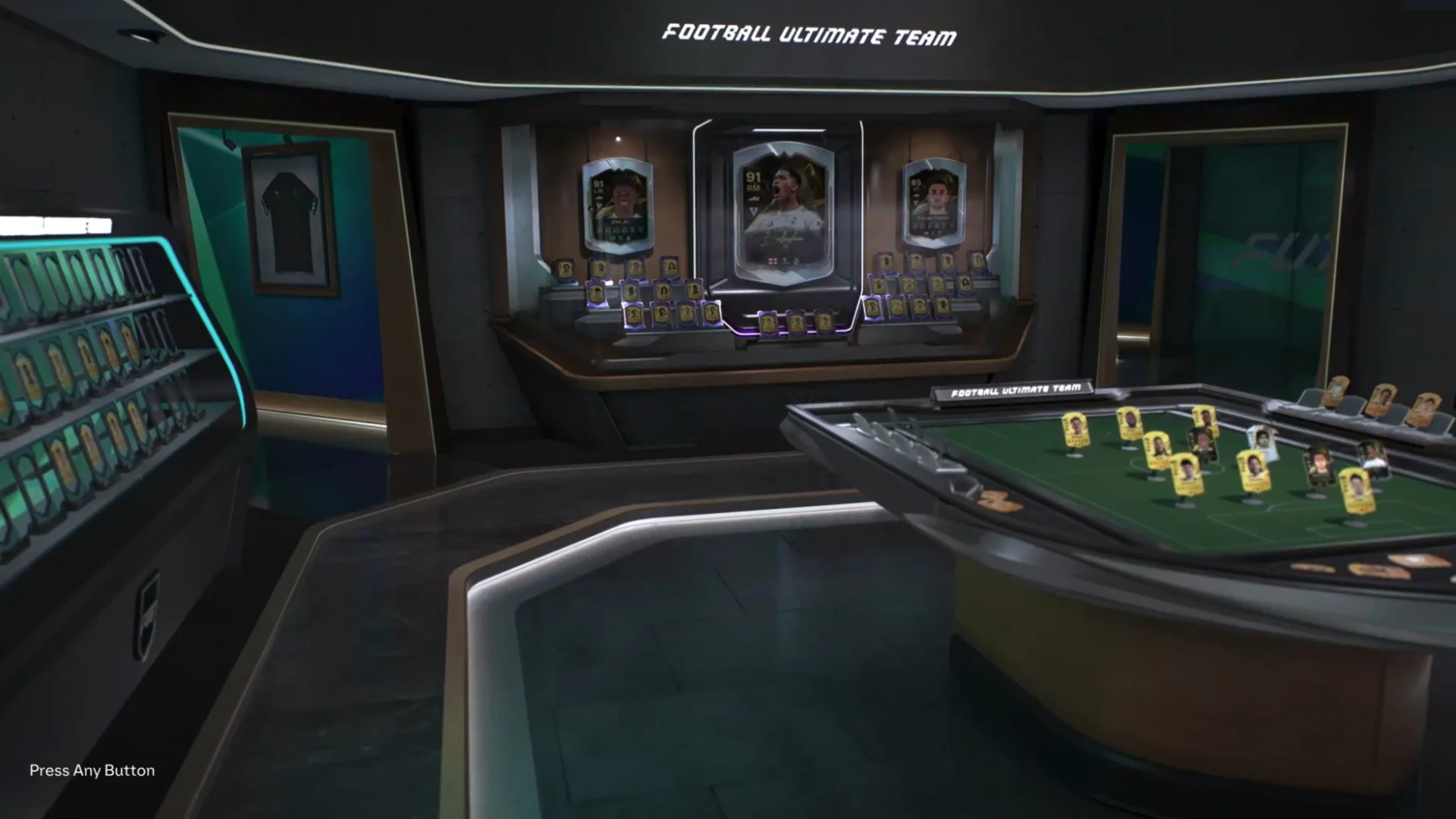
The Gallery is not the same as a Squad Building Challenge, the activity where you give up eligible cards for a reward. Some of those challenges now let you contribute cards toward a points target in stages. That is easier to understand than arranging a whole team around several conditions at once. But choosing what to submit still matters: you should not confuse a record of a card with permission to keep using that card after an exchange. We like the clearer collection system; it does not remove the pressure to acquire more players.
Small matches are the best reason to visit The Grounds
With your created Pro, you can walk around a shared football area and enter small matches or activities. That is The Grounds. It gives friends something less demanding than assembling a full team for Clubs. In a two-against-two match, you have fewer teammates to depend on and more opportunities to get involved yourself. That is a much clearer attraction than simply calling it an open world.

One activity, BucketBall, uses footballs and basketball-style hoops. You and a teammate move the ball into position, then try to send it into the opponents’ hoop with a lob or an aerial finish. In the official clip below, a blue player receives the ball close to the hoop and finishes above the defender. Changing the target changes the decision: a normal low shot at a football goal is not what you need here. It is a playful alternative when your group wants a short match with different rules.
Getting into that match is the problem. EA’s October 2 launch update acknowledges that Kickabouts, the shared informal games, are not attracting enough people to fill matches reliably. The team is looking at queues across servers and events to gather more players. Slow or unresponsive menus also remain under investigation. A social football area needs dependable ways to find a game. Walking between activities is much less appealing when you cannot get a match started or a menu stops responding.
There are positive player accounts of enjoying the smaller games with friends, and we can see their appeal. But the same launch period contains reports of long waits and disconnects. The October 2 patch improves matchmaking reliability; it does not establish that every queue or menu problem has disappeared. We would not buy FC 27 primarily for The Grounds in its current condition.
Platform differences, patches and our verdict
The version you buy changes what you can do. The Grounds and Clubs are available on PS5, Xbox Series X|S, PC and Nintendo Switch 2—not PS4, Xbox One or the original Switch. Playing the original Switch edition on a Switch 2 does not turn it into the separate Switch 2 edition. Nintendo versions also cannot join players on PlayStation, Xbox or PC. Check the version your friends own before planning an online group.
The Switch 2 edition runs matches at 30 frames per second, meaning the image updates 30 times each second. It is less smooth than a 60-frame presentation, particularly while following fast movement. Its separate player pool is another limitation for online buyers. On PC, Steam currently marks the game unsupported on the Steam Deck handheld. You also need the EA app and EA’s software for detecting cheating. Do not assume every machine or version provides the same experience.
Player ratings show why a single claim about the community would be misleading. On October 3, Steam’s English-language reviews were Mixed, with 52% positive from 2,146 reviews. PlayStation’s global PS4/PS5 rating was 3.87/5 from 33,507 ratings. The Xbox Ultimate Edition bundle page showed 3.7/5 from 503 reviews. These are different audiences and different rating systems, not three measurements that can simply be averaged into our score. Nintendo’s product page did not provide a comparable public player-rating total.
The more useful question is what people are reporting. PC accounts include enjoyment of the new defending and small matches, alongside delays in responding to button presses, disconnects and stuck menus. PlayStation’s written reports include passing-control and Clubs-position problems despite its higher aggregate rating. The Xbox bundle’s visible comments include pre-release reactions and very little detail, so they are weak evidence for how a specific mode performs today. We have not treated those comments as proof of a widespread Xbox-only fault.
Version 1.0.3 fixes specific faults, not every launch complaint. Its October 2 notes include a fix for short Ultimate Team match challenges, called Moments, getting stuck loading. A Manager Career bug that made highly motivated players request transfers was also addressed. In some Grounds activities, the most difficult dribbling tricks, called five-star skill moves, were unavailable; the patch fixes that too. EA is still investigating sluggish Grounds menus and inconsistent goalkeeping in one-against-one games. These remaining issues deserve a warning; the transfer-request bug should not be described as if it was never addressed.
Pixel Twelve verdict
We give EA Sports FC 27 a Pixel Twelve score of 6.5/10 — Fair. The football improvements and Manager Career decisions earn real credit. But we are evaluating the complete game on sale now. A better tackle does not compensate for an online match that disconnects, and a collection feature does not make paid random packs fairer. Those problems matter more to our recommendation than the number of modes on the menu.
For a new player, we would start with practice and offline matches, then Manager Career if choosing a squad and negotiating signings sounds enjoyable. Difficulty settings let you learn without immediately facing an experienced online opponent. Career is the strongest reason to buy. For someone who already owns FC 26, the transfers and manual-control changes are easier to justify than buying again mainly to walk around The Grounds.
Wait for further verified fixes if online reliability is your main concern. FC 27 can produce satisfying football, especially when you want to make the decisions yourself. It is not yet a game we can recommend equally to the offline manager, the competitive card collector and the group hoping for effortless matches with friends.
More from EA Sports FC 27
3 screenshotsLoading results
Check the age rating, official cover, trailer and available versions on our FC 27 game page. For a closer explanation of managing a club, read our Career Mode guide, or browse more Pixel Twelve reviews.