Rusty Goffe first entered Willy Wonka’s chocolate factory in the 1971 film. Fifty-five years later, he has returned to that world for Netflix’s reality competition Wonka’s The Golden Ticket — and this time his son Ben Goffe is part of the Oompa-Loompa ensemble beside him.
The father-and-son connection is the headline, but the full cast is the more interesting story. Netflix’s September 3 introduction names nine performers with different careers and life experiences: Rusty Goffe, Ben Goffe, Mitchell Marion, Tiffany Sarich, Beccy Benjamin, Ash Hodgkinson, Dane Noonan, Daniel Stone, and Alivia Mccarthy.
Together, they turn the show’s Oompa-Loompas into an ensemble rather than one repeated image.
Rusty Goffe connects two Wonka productions
Goffe’s return gives the competition a direct performance link to Willy Wonka & the Chocolate Factory. His presence is not presented as a digital recreation or a borrowed piece of archive footage. He is working on a new production decades after appearing in the 1971 film.
That distinction matters because the role is embodied. Costumes, movement, timing, and reactions are part of what the performers contribute to the factory around the contestants. Goffe brings lived knowledge of an earlier Wonka set, but he is not being asked to freeze that experience in place.
The new show has a different format and a different job for its ensemble. The connection works because a returning performer is participating in the present production rather than being used only as a nostalgic reference.
Ben Goffe makes the return a family story
Ben joining his father changes the shape of the casting detail. It is not simply a legacy cameo attached to one familiar name; it becomes a family collaboration inside a new ensemble.
Netflix’s introduction allows that relationship to sit beside the performers’ individual backgrounds. Ben is part of the same working cast, not only an extension of his father’s history. The two share a connection to the Wonka world, but each occupies his own place in the production.
For viewers who know Rusty from the 1971 film, seeing father and son together adds an immediate layer of continuity. For viewers arriving through the competition, the relationship works without requiring a history lesson: two performers from the same family are helping build the same strange workplace on screen.
The nine performers are deliberately not identical
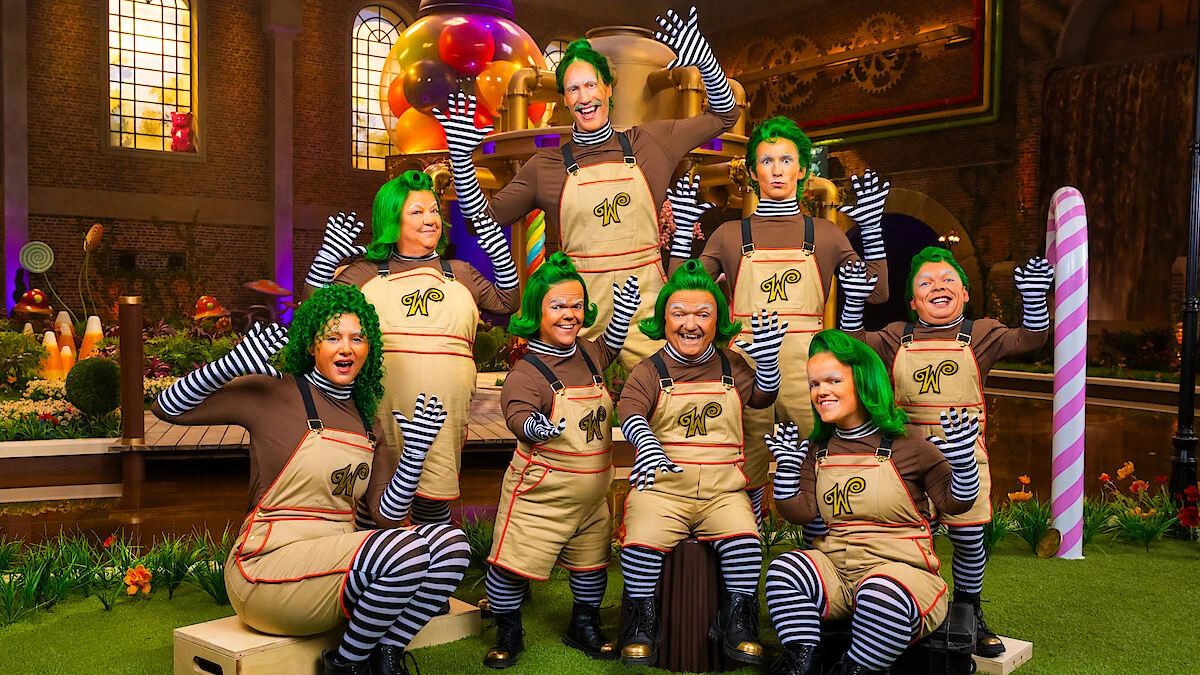
The showrunners told Netflix that they wanted variety in height, background, and personality. The casting reflects that choice. Mitchell Marion, Tiffany Sarich, Beccy Benjamin, Ash Hodgkinson, Dane Noonan, Daniel Stone, and Alivia Mccarthy arrive with their own performance experience alongside Rusty and Ben.
That approach avoids treating the Oompa-Loompas as interchangeable decoration. A reality competition depends on readable reactions and relationships inside the set. Giving the ensemble distinct performers creates room for recurring personalities, comic timing, and different ways of interacting with contestants.
It also makes the cast list worth recording accurately. The group image contains nine named people, and each name belongs to a performer contributing to the production. They should not collapse into a generic “Oompa-Loompa cast” credit when the official source identifies them individually.
A casting choice built around real performers
The Wonka brand carries decades of visual memory, which makes it tempting to talk about the factory only as design. This casting story pulls attention back to the people inside that design.
Rusty Goffe’s return supplies a genuine connection to the 1971 film. Ben Goffe turns that connection into a present-day collaboration. The seven other performers expand the ensemble beyond family history and give the competition its own group identity.
That is the useful way to understand the Oompa-Loompas in Wonka’s The Golden Ticket: not as one effect repeated nine times, but as nine credited performers whose differences are part of how the new factory works.