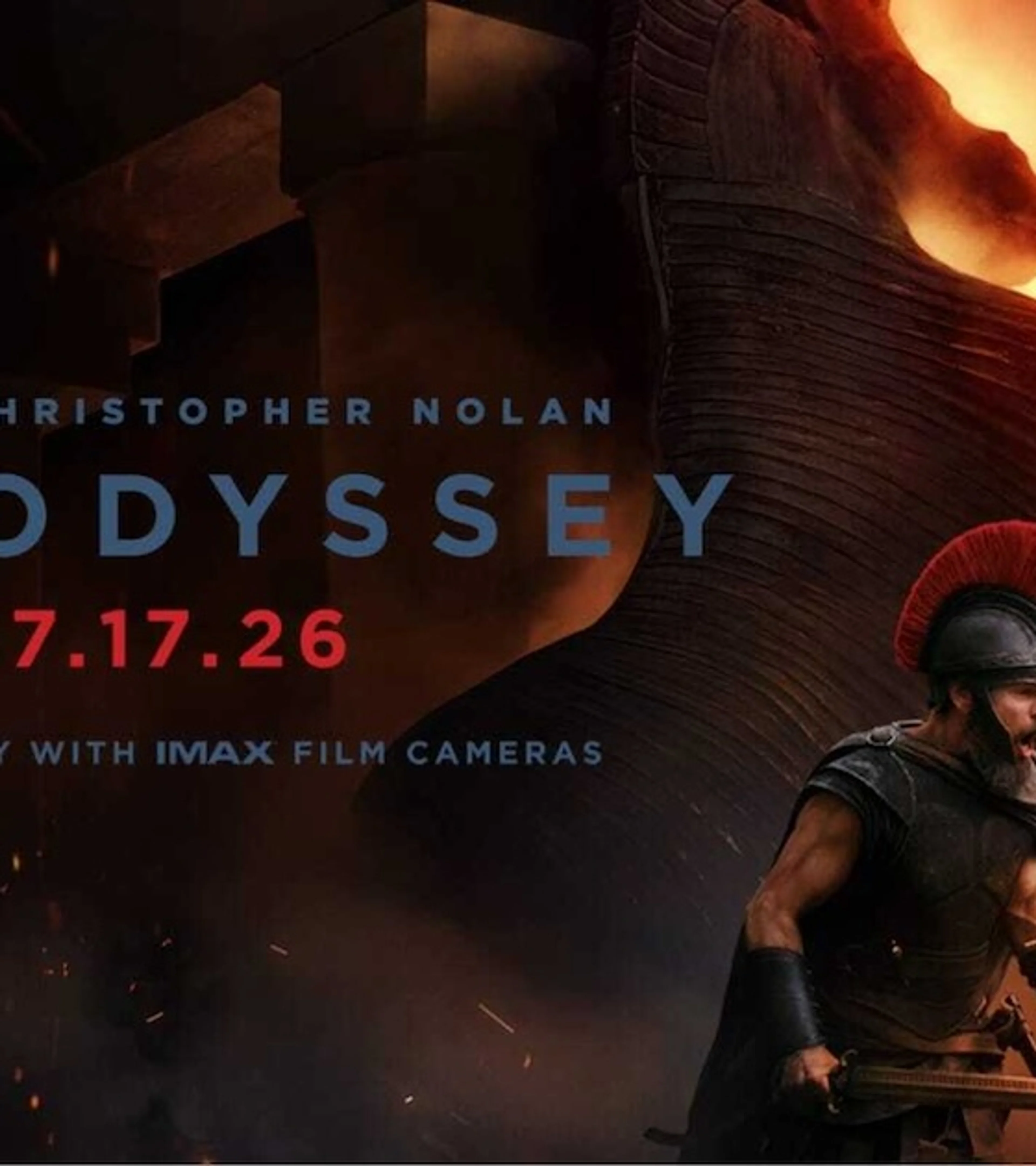
The Odyssey is already being sold like a movie that belongs on the biggest screen you can find. Christopher Nolan's new adaptation of Homer's ancient Greek epic opens in theaters on July 17, and Universal's official campaign keeps pushing one phrase to the front: shot entirely with IMAX film cameras.
That sounds like a premium-format flex, but it also creates a normal audience question: do you need IMAX 70mm to see the movie properly? The honest answer is no, although the rare version is still a big deal. The movie is playing broadly in theaters, but IMAX 70mm is only available in select locations, and many of the best showtimes have already become hard to get.
Why IMAX 70mm Matters
IMAX is the large-format theater experience built around a bigger screen, sharper image, and heavier sound. IMAX 70mm is the film version of that idea, using a massive film frame instead of a normal digital file. AP's format guide explains that Nolan sees it as the best possible presentation because the huge image can fill the viewer's peripheral vision and make the screen feel less like a flat rectangle.
The practical difference is scale and texture. A standard screen can still show The Odyssey, but a true IMAX 70mm room can reveal more height, more image information, and a more overwhelming sense of size. For a story built around gods, war, monsters, sea travel, and a long brutal journey home, that extra size is part of the sell.
There is a catch. The rare version is genuinely rare. AP counted only 32 U.S. and Canadian theaters showing Nolan's preferred IMAX 70mm presentation, with major venues like AMC Lincoln Square in New York and AMC Universal CityWalk in Los Angeles virtually sold out for weeks. IMAX's own ticket page lists participating theaters, but the larger point is simple: this is not available everywhere.
Advertisement

So Who Can Actually Watch It?
If the question is whether people can watch The Odyssey, yes. The film is opening in theaters, and the official site points audiences toward local showtimes. If the question is whether everyone can watch it in IMAX 70mm, no. Most viewers will see it in another format: IMAX digital, IMAX laser, Dolby Cinema, a regular 70mm print, another premium large format, or a standard auditorium.
That should not be treated like a punishment. Nolan told AP that the team scans the original film material carefully for digital formats, so IMAX laser and Dolby Cinema still benefit from the detail captured by the original IMAX cameras. A nearby laser IMAX or Dolby screen may be a much better experience than chasing a sold-out 70mm ticket across the country.
The main thing to avoid is confusion. IMAX 70mm, standard 70mm, IMAX digital, and Dolby are not the same thing. The labels matter. If someone wants the rarest version, they should look specifically for IMAX 70mm Film on the theater listing. If that option is not nearby, the next best move is usually the largest, best-maintained premium screen available.
The Camera Nerd Part
The coolest technical detail is not only that Nolan used IMAX cameras. It is that The Odyssey is the first feature shot entirely on IMAX film, which used to be almost impossible for dialogue-heavy scenes. IMAX film cameras were famously loud, bulky, and difficult to use the way a normal movie camera is used.
AP's guide says the production used a new muffling system called a blimp, with a customized IMAX camera named The Keighley. Inside that setup, the camera weighed around 300 pounds, film had to be reloaded every two-and-a-half to three minutes, and a mirror system helped actors see each other around the huge camera during scenes.
A small camera theory follows from that: this probably changed the rhythm of the movie, not just the image quality. When the camera is that heavy, loud, and hungry for film, shots have to be planned with unusual discipline. Nolan and cinematographer Hoyte van Hoytema could not casually chase every angle. They had to build scenes around scale, blocking, and where the audience's eye would land in different theater shapes.
That is also why cropped or digital versions should still hold together. Nolan's team plans for multiple aspect ratios, so the 1.43:1 IMAX frame can feel enormous without making the standard versions look broken. The 70mm IMAX version may be the dream version. The wider release is still part of the plan, not a leftover.
The Odyssey has turned a format choice into part of the movie's identity. That can be frustrating if the nearest IMAX 70mm theater is nowhere close. It also says something useful about why this release feels like an event: people are not only buying a ticket to see Nolan adapt a myth. They are trying to see whether a movie can still make the theater itself feel myth-sized.