Pixel Twelve
Baba Is You Beginner Guide: Read the Rules and Move Word Blocks

How To

Baba Is You Beginner Guide: Read the Rules and Move Word Blocks

A visual, spoiler-light guide to Baba Is You for first-time players, using six official screenshots and two original diagrams to identify the character, word blocks, active rules and common traps.

By Ryan CooperGame: Baba Is YouVerified Sep 24, 2026
Guide Type
How To
Last Verified
Sep 24, 2026

Guide details

Overview

A visual, spoiler-light guide to Baba Is You for first-time players, using six official screenshots and two original diagrams to identify the character, word blocks, active rules and common traps.

What you are looking at

Baba Is You is a puzzle game where you can move some of the words that tell the level how to work. It is not a quiz about English grammar. The little white creature is Baba. A line of word blocks such as BABA IS YOU is a rule, and a white Baba drawing is an object affected by that rule. Move one square at a time, watch what changes and undo an experiment that traps you.

The six official pictures below come from different levels. They are examples of how to read the screen, not a sequence of moves for one exact puzzle. Your first level may have fewer words and a different layout. Focus on the coloured word tiles, the small objects they name and the empty squares you can use to get around them.
1. Find Baba, then find the rule that makes Baba yours

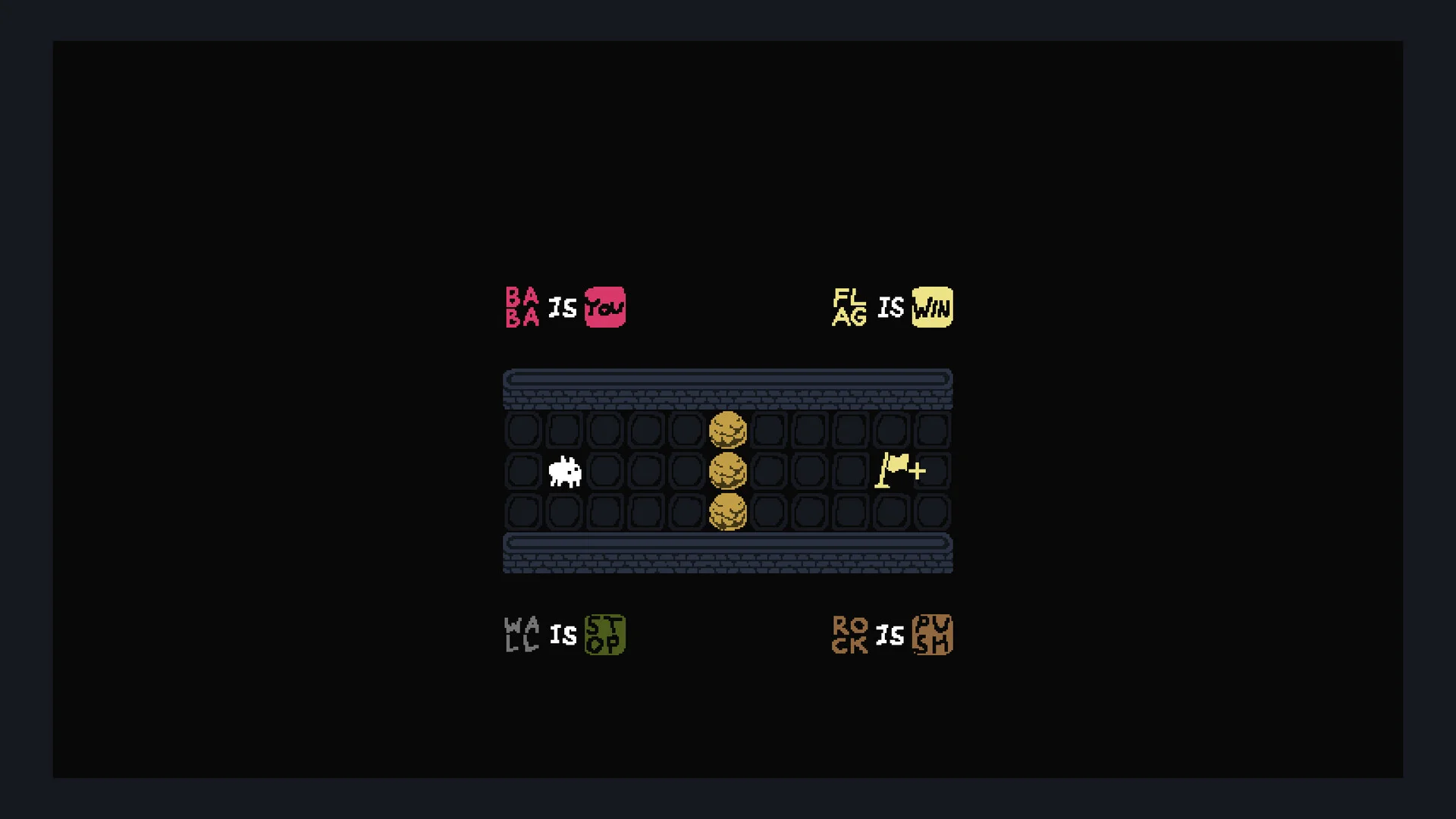
A white Baba stands left of three rocks; BABA IS YOU and FLAG IS WIN are connected above the board, with WALL IS STOP and ROCK IS PUSH below.
Start with the small white Baba inside the corridor. The pink BABA IS YOU sentence above it explains why your direction input moves that character.
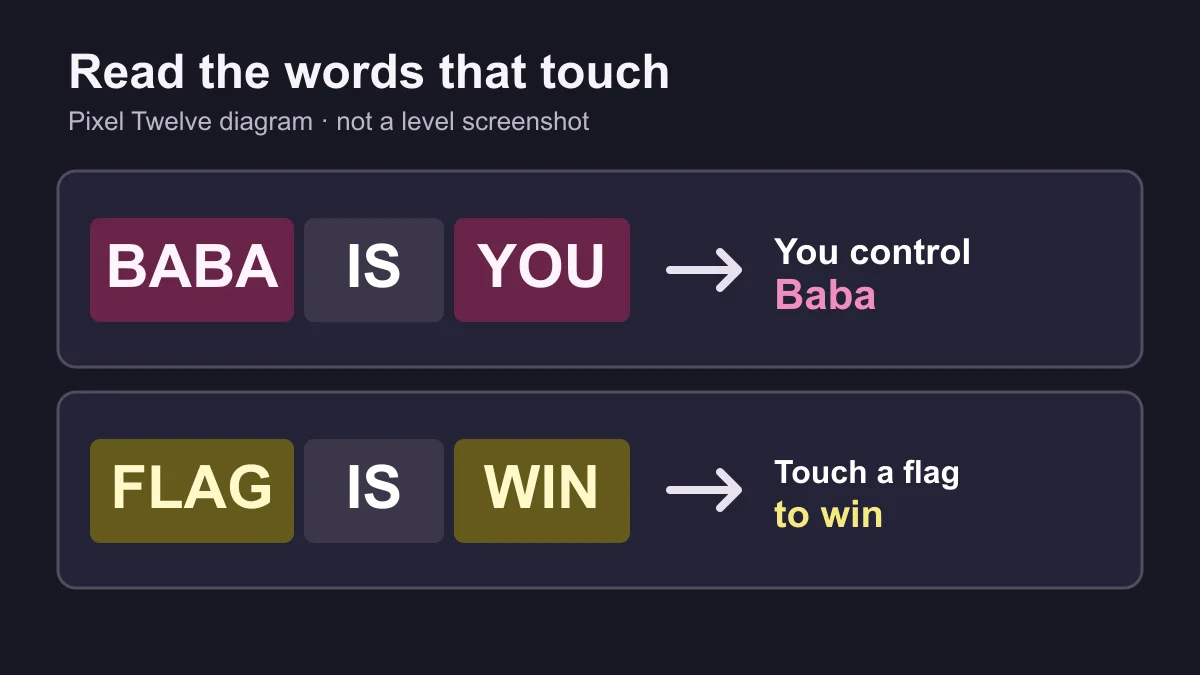
Pixel Twelve diagram showing connected BABA IS YOU and FLAG IS WIN word blocks, with the meaning of each rule in large type.
Pixel Twelve diagram, not a level screenshot: the touching words BABA IS YOU give you control of Baba; FLAG IS WIN makes a flag the goal.
  1. Look inside the narrow corridor in the middle of the picture. The white four-legged shape at left is the Baba object. The pink BABA, white IS and pink YOU tiles above the corridor form BABA IS YOU from left to right. That complete rule gives you control of Baba. On your own board, find both the object and the matching word sentence before touching anything else.
  2. Press a movement direction once and watch which object changes square. If the white Baba moves, you have confirmed the current YOU rule. If a different object moves, look for another complete sentence ending in YOU. Direction buttons vary by system and can be remapped; the useful test is one safe move into an empty square.
  3. Now look for the yellow FLAG IS WIN sentence above the corridor and the yellow flag drawing to the right of the rocks. With that rule active, moving a YOU object onto a flag can win. It does not tell you that the rocks are already passable. Read the other sentences before trying to cross.

The grey WALL IS STOP and brown ROCK IS PUSH sentences below the corridor explain the obstacles here. STOP blocks movement. PUSH means the object can be shoved when there is space behind it. Do not mix up the word ROCK with the three rock drawings in the passage.

2. Scan the whole board for complete sentences

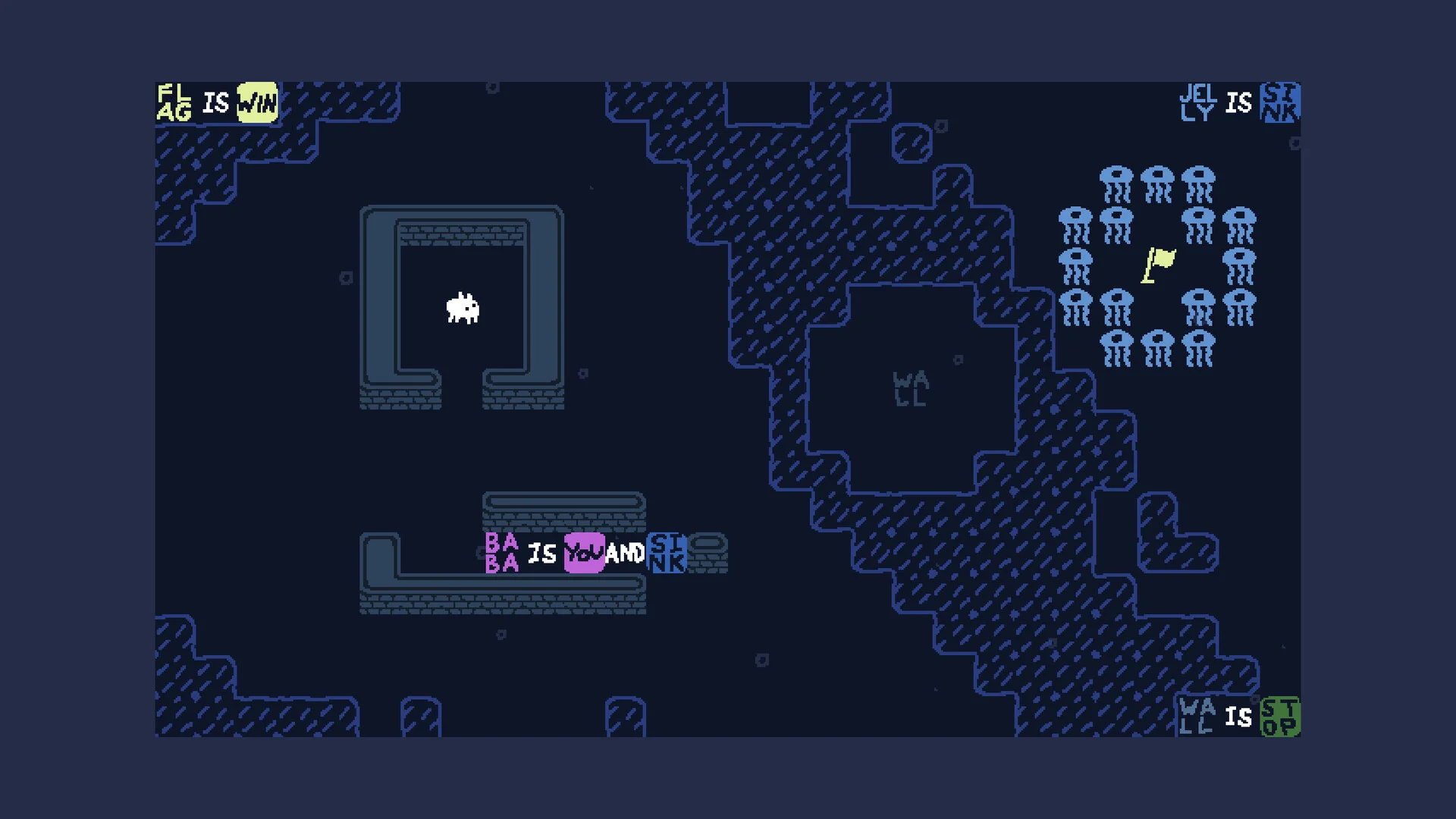
A blue board shows the flag and FLAG IS WIN at upper left, JELLY IS SINK at upper right, BABA IS YOU near the bottom and WALL IS STOP at lower right.
The rules are spread across the corners. Check every edge before deciding that the flag or a wall behaves the way it did in the last level.
  1. Begin at one corner of your level and read each cluster of tiles that touches horizontally or vertically. In this picture, FLAG IS WIN is in the upper left, while BABA IS YOU is low and left of centre. A rule can be far away from the object it changes; the flag drawing is on the right side.
  2. Say each complete sentence in plain words. FLAG IS WIN means a flag is a goal. WALL IS STOP means wall drawings block a controlled character. The upper-right JELLY IS SINK group warns that jelly has a different effect from a wall; do not treat every coloured object as the same kind of obstacle.
  3. Then find the small objects those words name. The flag is a yellow drawing among blue jelly shapes; the text FLAG is a block elsewhere. Make a two-column mental list: rule on one side, matching object on the other. If you cannot find an object yet, keep the rule in mind rather than guessing what the unknown shape is.

Read again after you push a word. The board can change immediately, so the first scan is only the starting position. In later puzzles a rule may be vertical, may share a tile with another word or may be hidden behind an object; the basic habit still works.

3. Tell word blocks from the things they name

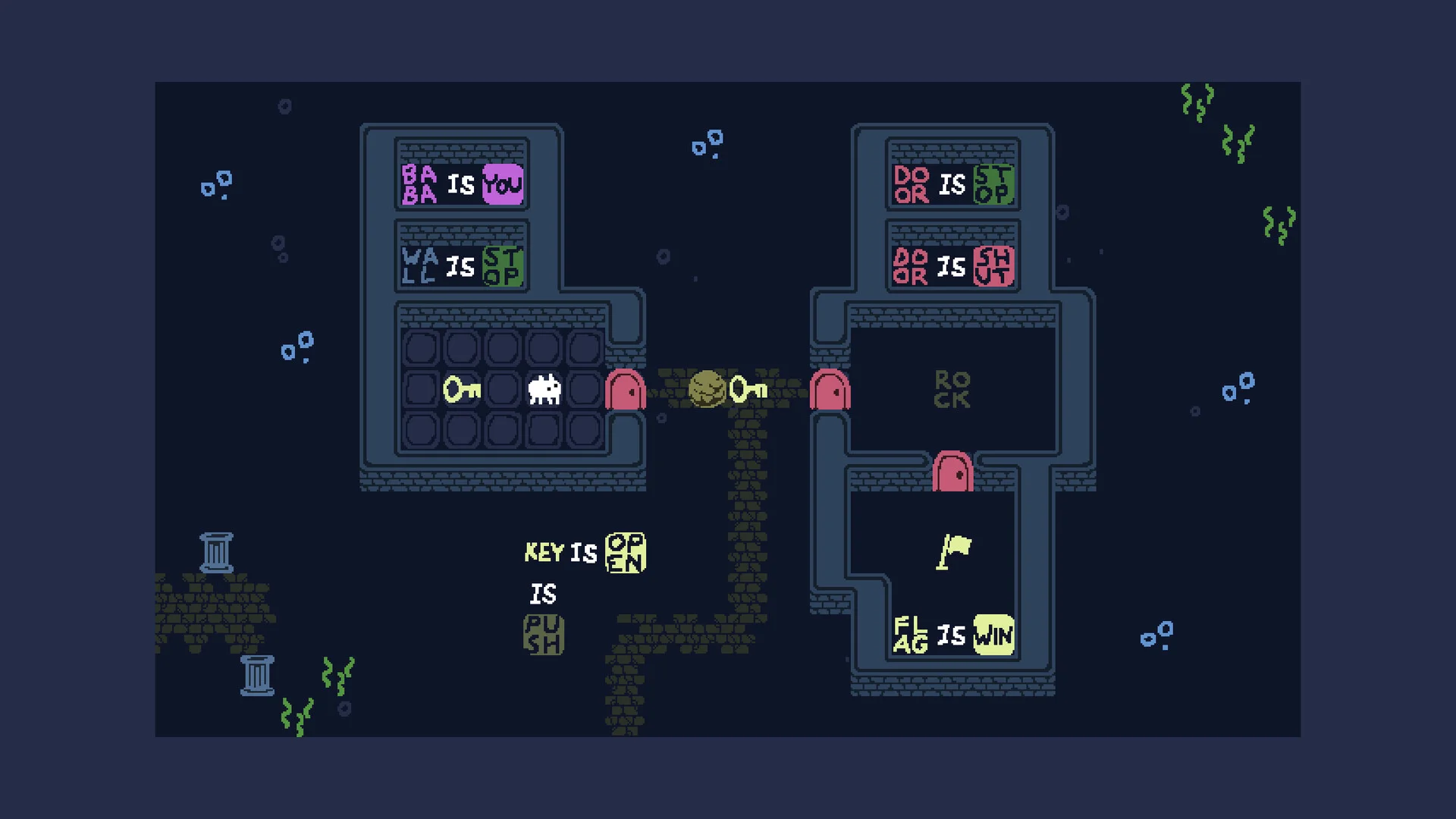
A split board shows a white Baba and yellow key on the left, pink doors on the right, and rule tiles reading DOOR IS STOP, DOOR IS SHUT, KEY IS OPEN and FLAG IS WIN.
The yellow key drawing beside Baba is an object. The yellow KEY tile near the lower middle is a movable word; the nearby KEY IS OPEN sentence changes what key objects can do.
  1. Find Baba in the left room, then find the yellow key drawing one square to its left. That drawing is the item in the room. Near the lower middle, KEY is written on a yellow square next to IS and OPEN. Those are word blocks, not another key you can pick up.
  2. Read the two door sentences in the upper-right boxes. DOOR IS STOP says door objects block movement. DOOR IS SHUT gives them a second property. KEY IS OPEN tells you what the key object can do when it meets something SHUT. You do not have to memorise every property before play; read the active words and test the interaction safely.
  3. Before pushing a word block, inspect the square directly behind it. If that square is a fixed wall or an edge, a one-way push can leave the word stuck. Try moving around the block first so you can approach from the side you need. This is especially important when a sentence is your only way to reach a flag.

Notice the separate IS and PUSH tiles below the key sentence. They are not magically a rule on their own. They need a matching subject such as ROCK placed in the correct line. The game rewards checking the current shape of the sentence, not guessing from a loose word.

4. A sentence works only while its words connect

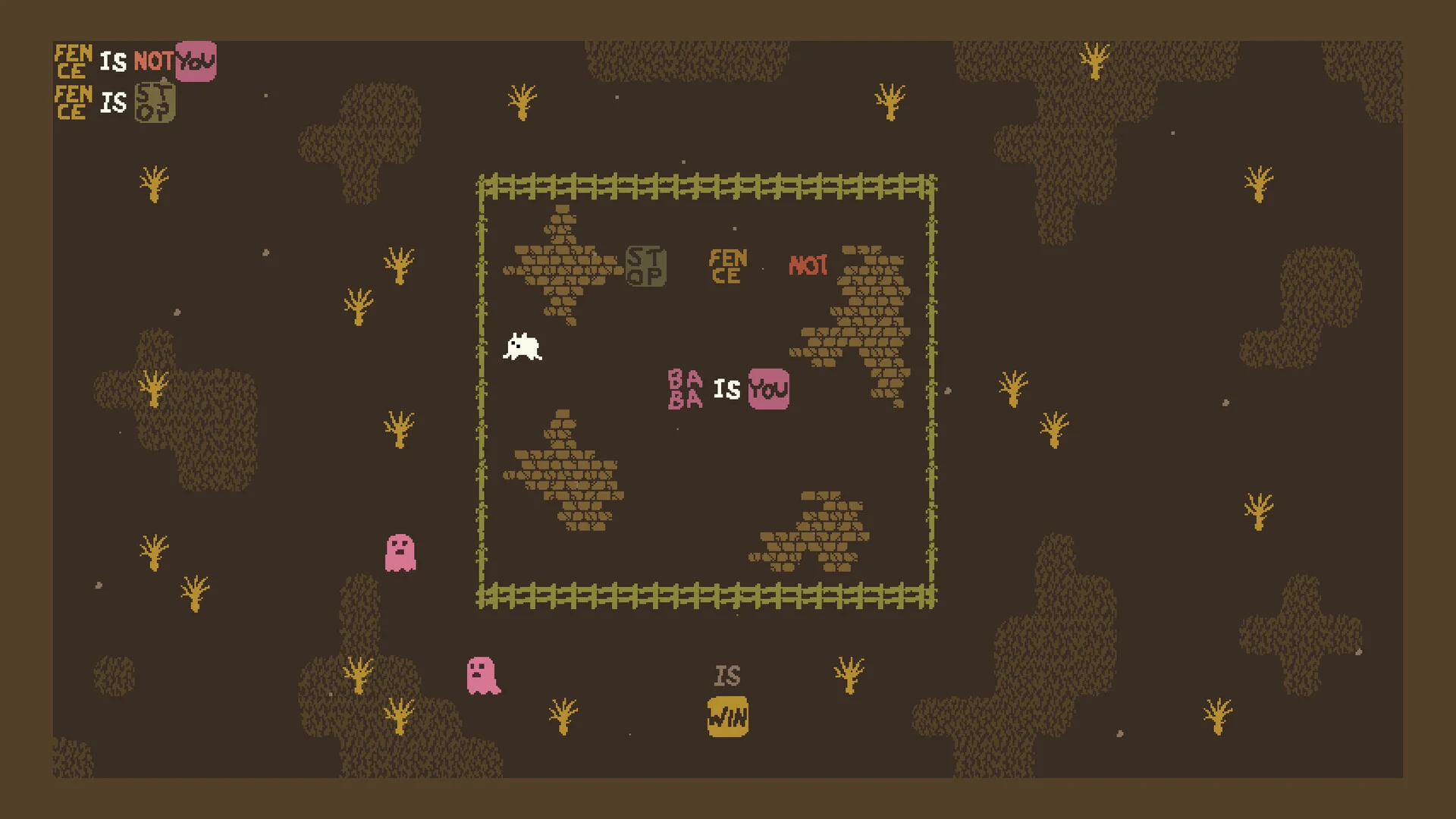
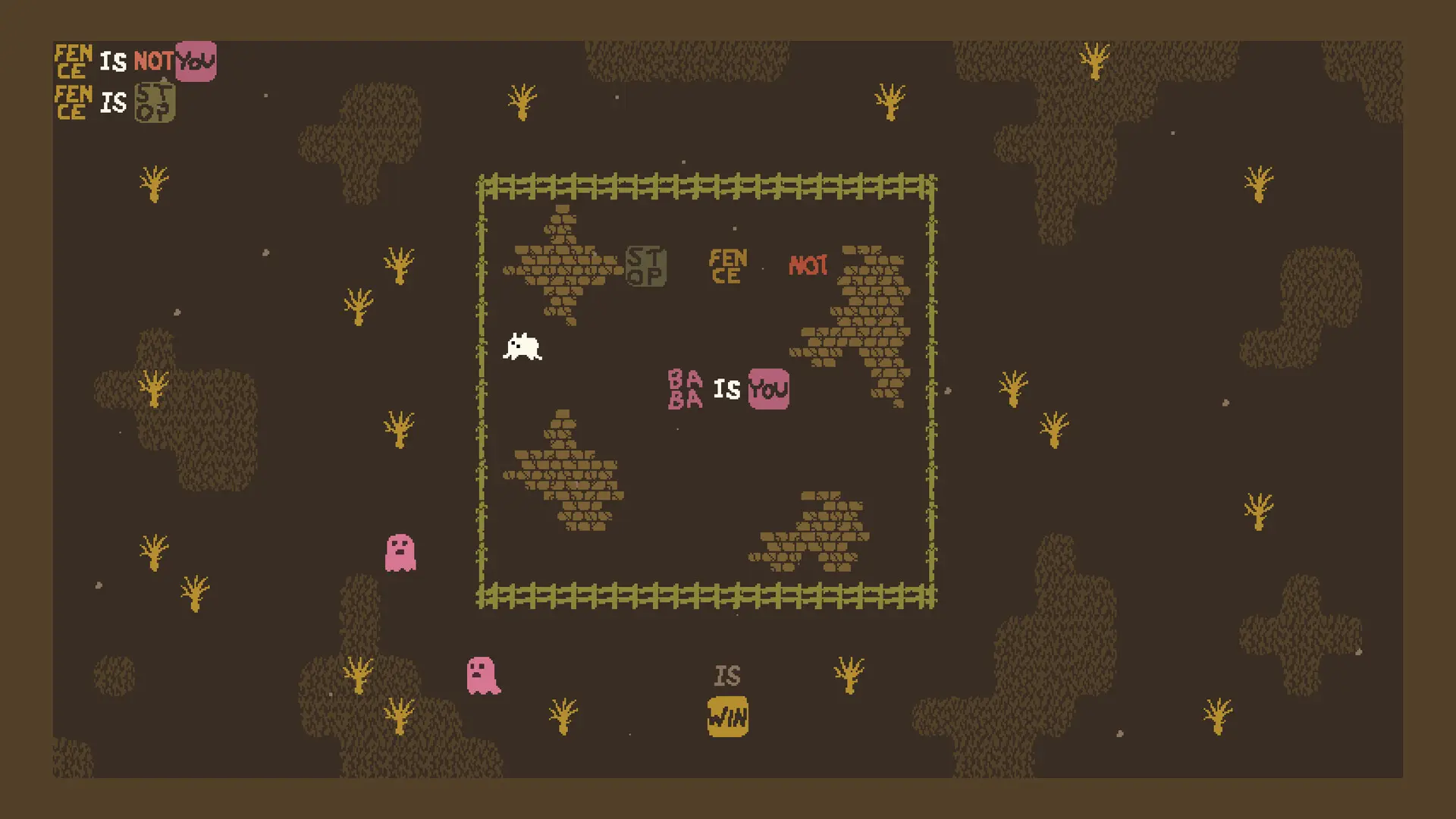
A brown board has FENCE IS STOP and FENCE IS NOT YOU at upper left, BABA IS YOU in the central enclosure and separate IS and WIN tiles below it.
BABA IS YOU is complete in the centre. The loose IS and WIN below the enclosure are not yet a win condition; an object word must connect to them.
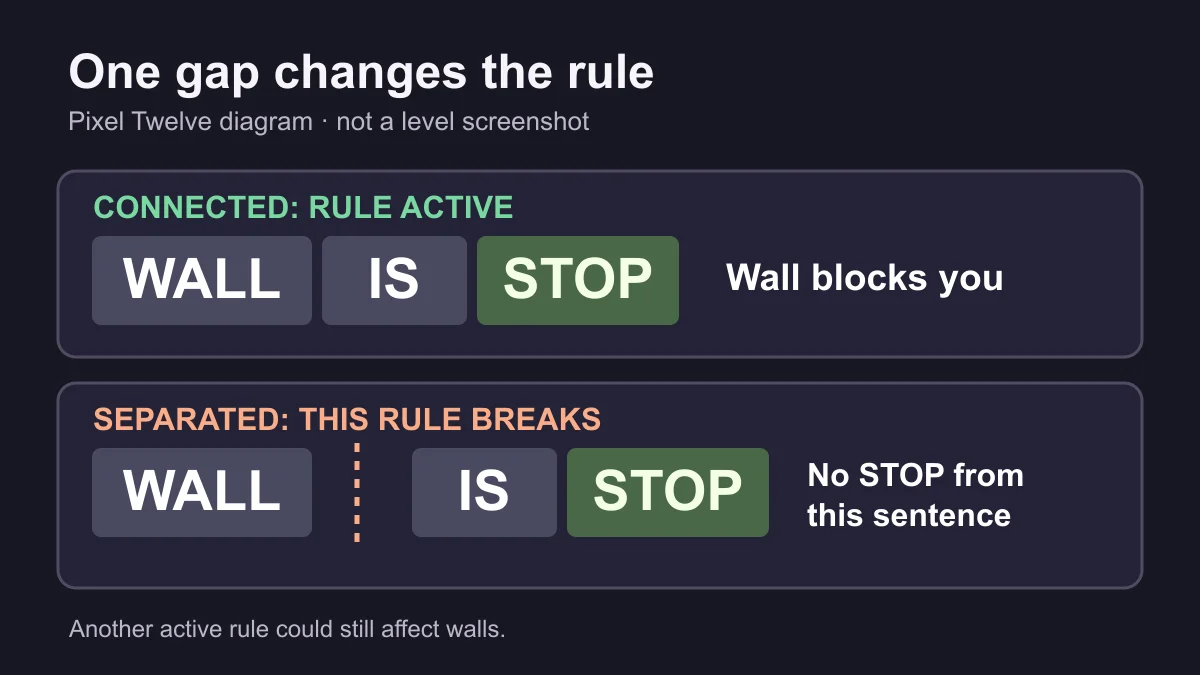
Pixel Twelve comparison diagram showing WALL IS STOP connected and active, then separated by a gap and inactive.
Pixel Twelve diagram, not a level screenshot: separating WALL from IS STOP breaks that particular rule. Other active rules may still affect walls.
  1. Look inside the fenced square in the centre. Pink BABA, white IS and pink YOU touch in one row, so BABA IS YOU is active. Just below the fence you can see a loose IS above a yellow WIN. Those two words alone do not name an object and do not make a finish line.
  2. The upper-left corner contains FENCE IS STOP. That applies to the fence drawings around the enclosure. If you can move one of those word tiles and break the sentence, the fence may stop blocking you. Check whether the needed tile is actually reachable before planning around that idea.
  3. Do one safe experiment: choose a movable word with empty space behind it, push it one square and immediately inspect the board. Did a sentence become complete, break apart or stay unchanged? If the result blocks every route, use Undo and try a different approach. You are testing the rule, not committing to the whole solution.

The pink character outside the fence shows why you should inspect more than the centre. Several objects can share a name, and one rule may affect all of them. This screenshot is an example of incomplete sentences, not a promised answer to this exact level.

5. Protect a YOU rule before moving its words

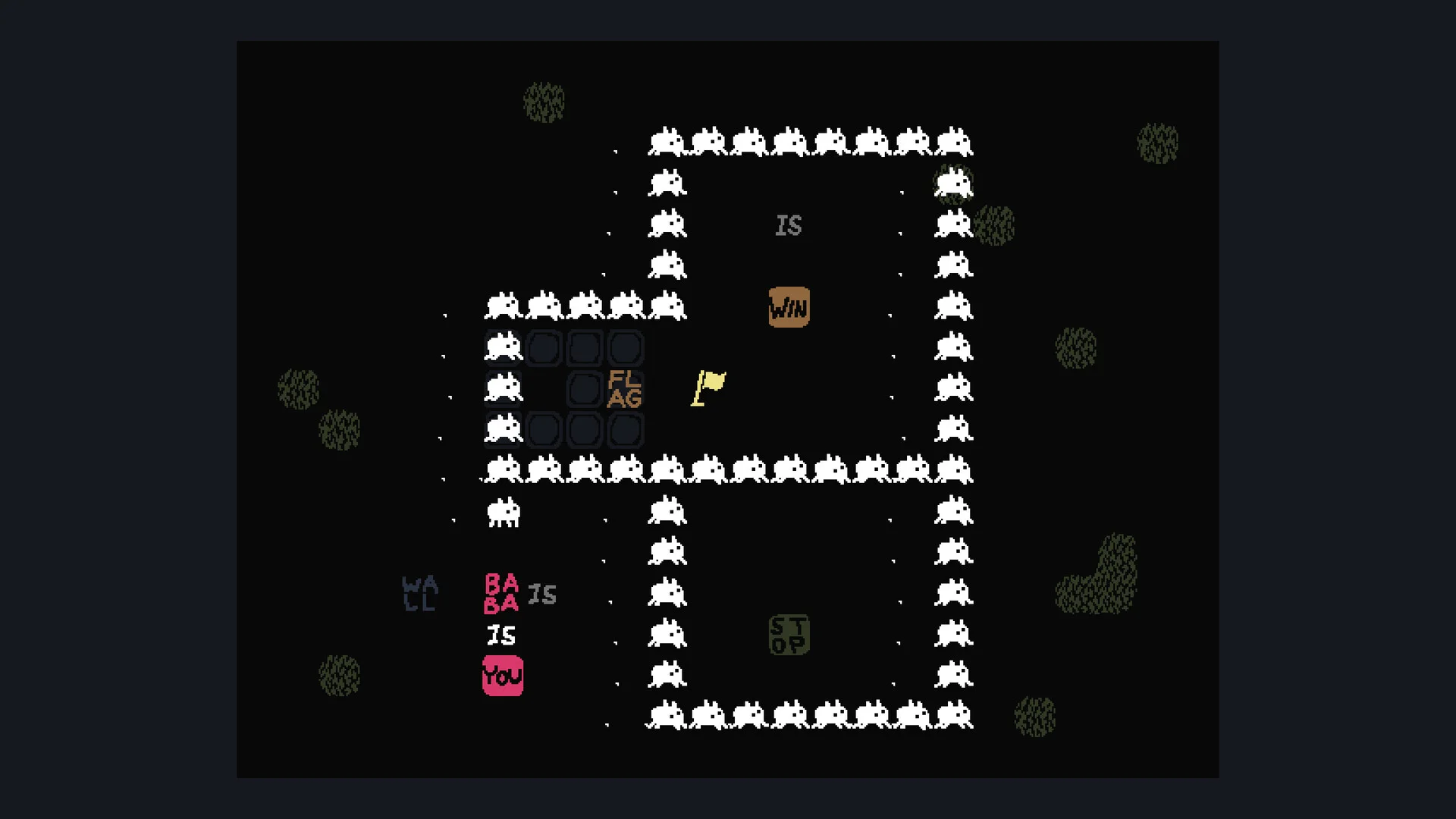
A black maze is outlined by many white Baba characters; a vertical BABA IS YOU sentence sits near the lower left beside loose word blocks and a yellow flag.
The vertical pink BABA IS YOU group is the control rule. It matters even when there are many Baba drawings on the board.
  1. Look near the lower-left corner. BABA, IS and YOU are stacked vertically, so this is a complete rule even though it does not run left to right. All the white Baba drawings around the maze can respond to one movement input while that rule is active.
  2. Before you push one of those three word tiles away, ask what you will control afterward. If you break the only sentence ending in YOU and have no replacement, a direction input may no longer move anything useful. That is a soft lock in your experiment, not proof you must delete your save.
  3. If movement stops after a word push, first scan for a newly formed YOU sentence elsewhere. If none exists, use Undo to return the word to its previous square. If you have made several confusing changes, Restart returns to the level start. The game provides these recovery actions so you can try ideas without treating a mistake as permanent.

Do not infer that every white Baba is a separate player. The rule says which kind of object your input controls. The number of matching objects can change while you play.

6. When new properties appear, learn one at a time

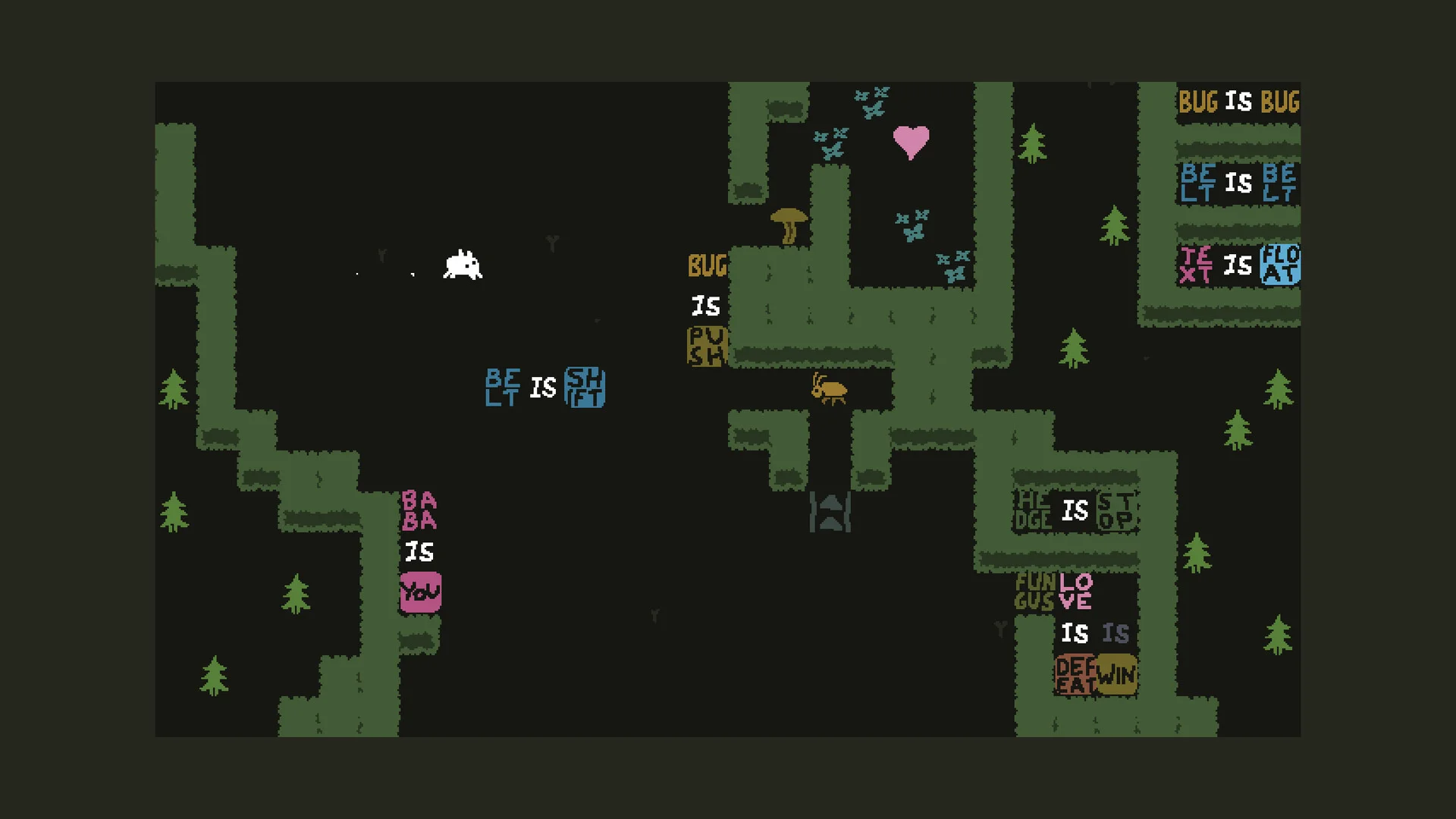
A green board places BABA IS YOU at lower left, BELT IS SHIFT near Baba, TEXT IS FLOAT at upper right and other rules around small bugs and hedges.
Later screens add properties such as SHIFT and FLOAT. You can still start with the same three questions: what is YOU, what is WIN and what is blocking the route?
  1. In this green example, find BABA IS YOU in pink at the lower left. That is still your starting point even though the board has more words than the first screenshot. Next find the flag or another winning rule. If you cannot identify a winning rule, keep scanning instead of moving at random.
  2. Near the middle-left, BELT IS SHIFT introduces a property that was not needed in the simple corridor example. At the upper right, TEXT IS FLOAT changes how word tiles can interact. Read each complete rule, locate its matching object and make one small test to see its effect. You do not need to learn all advanced words from a list before meeting them in a level.
  3. When the board feels busy, ignore decorative ground for a moment. Follow coloured text blocks first, then the objects they name. A rule that remains fixed behind a wall is still active even if you cannot push it. A movable rule is an opportunity, not an instruction that you must change it.

This is a later official screenshot; its exact puzzle is intentionally not solved here. The repeatable skill is reading the board before each experiment.

7. Use Undo and Restart as puzzle tools

  • Undo is for one or several recent moves. Use it after a word enters an unreachable corner, a wall becomes solid around you or the last YOU sentence breaks. Return to the position before the experiment, then approach the word from another side.
  • Restart is for a board that has become hard to read after many moves. It restores the level layout so you can test a new plan from the same starting point. It is not a punishment or a new-game reset.
  • The shortcut or button for these actions depends on your platform and any controls you changed. The game displays control hints and has a pause menu; check your own control labels instead of trusting a keyboard shortcut from a different version. The screenshots here show puzzle boards, not a universal controller layout.

A small routine for any new level

  • Find the object you can move. Then locate a complete sentence ending in YOU and make one safe move to confirm what your input controls.
  • Find a complete WIN sentence and its matching object. Notice what lies between your character and that object.
  • Scan all edges for STOP, PUSH and other active properties. Match each word to the small drawing it names; do not mistake a word tile for the object.
  • Choose one rule to test. Check that the target word has space behind it and that you can still reach the side needed for another push.
  • Move once, read the sentences again and watch what changed. Undo if you lose control or trap a needed word. Keep the idea that worked even if you restart the board.

If you are stuck on the first few boards

  • Baba will not move: look for a complete YOU rule. The rule can run vertically. If you just broke it, use Undo.
  • The flag does not finish the level: check whether FLAG IS WIN is complete right now and whether a YOU object actually touches the flag drawing.
  • A wall or rock behaves differently from the last level: read WALL IS STOP or ROCK IS PUSH on this level. Rules can change between boards and during one board.
  • A word refuses to move: examine the square behind it. You cannot push a block into an occupied or impassable square unless an active rule changes that interaction.
  • A screenshot here does not match your opening level: that is expected. These official images teach how to recognise words and objects across several example boards, not the exact moves for one named stage.

Get Pixel Twelve's biggest stories first.

Add as a preferred source on Google