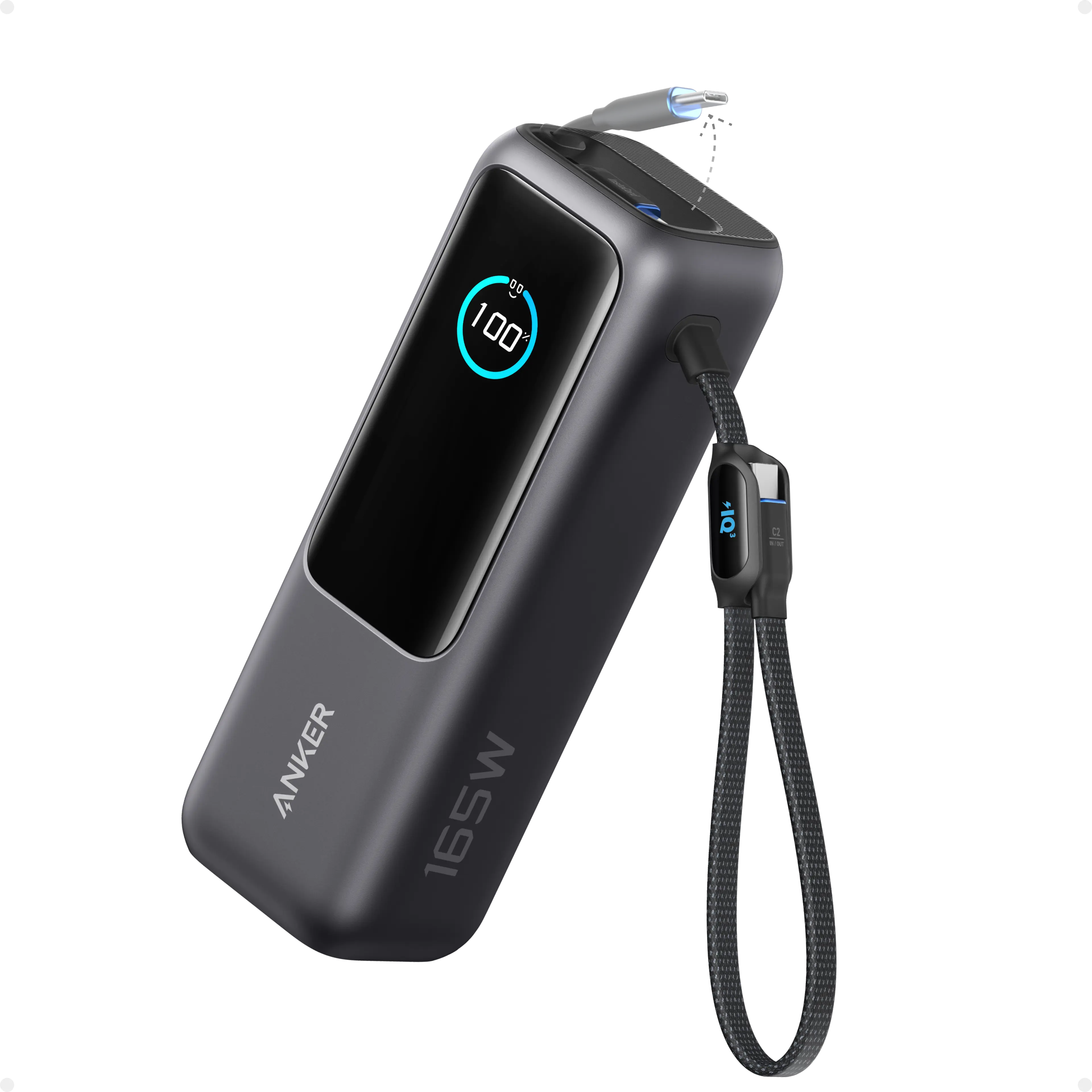
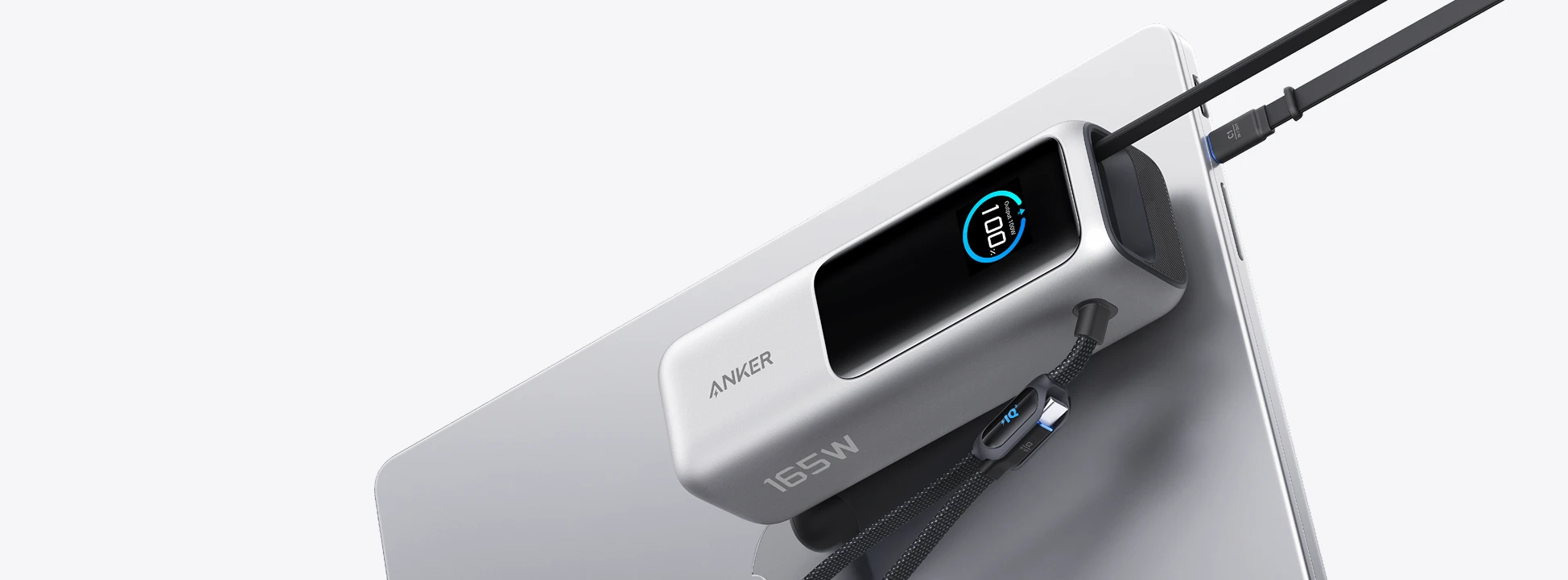
The Anker Laptop Power Bank 25K makes the most sense when you carry a laptop and a phone, already have room in a bag, and would rather not pack separate USB-C cables. Its two built-in cables are the main reason we would choose it. The 165W headline needs more explanation: that is combined output, not the charging speed available to one laptop.
We tested the A1695, and our recommendation is a qualified yes for that multi-device use. We would not choose it just to recharge a phone during a short outing. Its size is a real compromise, and recurring owner reports about cable failures deserve attention before buying a product whose convenience depends so heavily on those cables.
Two built-in cables, but not a pocket-sized charger
One USB-C cable retracts into the top of the power bank; the other forms a short carrying loop. The retractable cable reaches about 70cm, while the loop cable is about 30cm long. That gives you two different working distances without having to untangle a loose lead. We prefer the longer connection for a laptop on a table and the shorter one when the devices can sit together.
There is also a separate USB-C socket and a USB-A socket. You can connect up to four devices, although the two sockets require your own cables. A Lightning iPhone or another device without USB-C does not gain the same cable-free convenience. This is a better fit for a mostly USB-C setup.
At a rated 595g, or roughly 21oz, the A1695 adds noticeable weight before you pack a wall charger. Its 157 × 54 × 49mm body is also much thicker than a phone. We would make space for it in a laptop bag, not buy it expecting comfortable pocket carry. Someone who only needs an emergency phone top-up should prioritize a smaller battery instead.
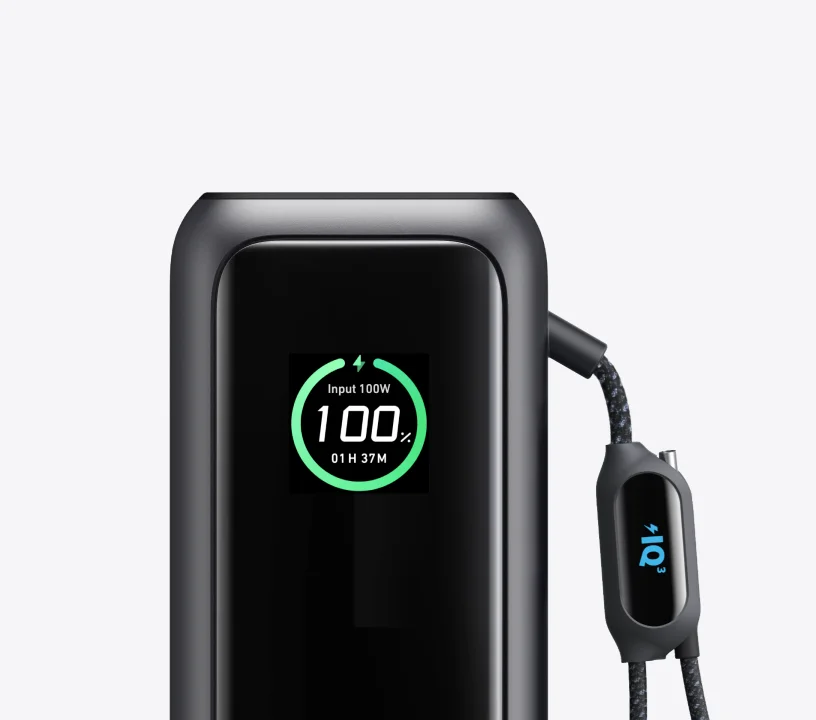
The display is useful for understanding what is happening rather than simply showing a row of battery lights. It reports remaining charge and input/output power. We value being able to check whether the battery is accepting power or supplying a connected device, especially when sharing it between several pieces of equipment.
What 165W actually means
Each USB-C connection is rated for up to 100W, not 165W. Anker specifies up to 165W combined across two USB-C connections, with the total dropping to 130W when three or four devices are connected. These are output limits, not a promise that every device will charge at its fastest possible speed.
Check your laptop's USB-C charging requirements before buying. A computer designed around a higher-powered adapter may charge more slowly, or continue losing battery under a demanding workload. For a gaming handheld such as Steam Deck, the relevant question is how much power the device accepts while running your game, not how large the number on the power bank looks. We see the Anker as a more sensible option for a bag carrying a handheld and a phone than for someone who needs a lightweight charger for just one device.
Temperature management also affects sustained charging. Anker documents reduced-power cooling modes and a protection mode that stops charging. That is important context if you expect the maximum wattage throughout a long session. We would buy this for flexible charging, not for guaranteed continuous 165W output.
The battery's rated capacity is 25,000mAh, or 90Wh. That does not mean 90Wh reaches your laptop: conversion losses and the laptop's own power use reduce the energy available to refill its battery. We would not plan a trip around a fixed number of full laptop charges without checking the actual computer and workload.
Recharging the A1695 itself supports up to 100W input. A suitable wall charger is sold separately, so include that in your budget if you do not already own one. Buying a large power bank and filling it from a low-powered phone adapter can make the time between uses inconvenient, even when the power bank's output is sufficient for your laptop.
Cable durability matters more than the headline wattage
Buyer feedback supports the appeal of the integrated cables and charging flexibility, but it also introduces a limitation that a short review cannot settle: long-term cable reliability. In the A1695 feedback we examined, multiple owners reported failures of the braided loop cable; others described retractable-cable or retaining-piece problems. These reports covered both black and silver units. They are owner reports, not failures we are claiming occurred in our test, and they do not establish a product-wide failure rate.
The distinction matters. A replaceable loose cable is straightforward to swap; an integrated cable is part of the product you paid for. The separate USB-C socket still gives the design another connection option, but that does not make losing a built-in cable acceptable. We would keep the receipt and warranty details, and check each connection during the return period.
The broader buyer response remains positive. On September 18, 2026, Amazon's listing showed 4.4/5 from 12,043 global ratings across its listed color variants. Best Buy's black A1695H11 listing showed 4.8/5 from 281 reviews. Those are separate retailer snapshots, not the Pixel Twelve score. Best Buy labels many reviews as incentivized, and the two audiences should not be treated as one equivalent sample.
Weight is a recurring reservation even in favorable feedback. Charging speed, fewer loose cables and the display attract repeated praise. For laptop-bag use, we think that exchange is reasonable; for lightweight phone-only carry, it is much harder to justify. Cable durability remains a separate concern regardless of which use case fits you.
We also checked Anker's A1695 support material for software remedies. As of September 18, 2026, we did not find a published user-installable firmware update or A1695 changelog. Do not buy it expecting a future update to resolve a cable fault. Our assessment applies to the A1695, not Anker's separate app-enabled Prime models.
Why our score is 8/10
The Pixel Twelve score is 8/10. We recommend the A1695 for people who need flexible USB-C charging and are comfortable carrying its weight. We are more cautious than the strongest professional ratings and Best Buy's buyer average because integrated-cable failures affect its defining feature, while temperature-dependent output limits its appeal for sustained high-power use.
The four professional scores we verified normalize to a 9.15/10 mean and 9.3/10 median. Our score sits 1.15 points below that mean: we give the longer-term cable reports and carrying compromises more weight than an assessment focused mainly on charging convenience. That is not a rejection of the broadly positive owner response. It is the difference between recommending this for a particular laptop bag and recommending it without reservations.
Buy it for the built-in cables and multi-device flexibility. Skip it if low weight, easily replaceable cables or sustained high-output laptop charging are your priorities.